Posts

Showing posts with the label Africa

Wrestling with the Devil by Ngugi wa Thiong'o

Image
This review was first published in the Fall 2018 issue of Rain Taxi Review of Books . (I have kept the page references in that are provided for the Rain Taxi copyeditors, but which are cut from the printed version.) At the end of December 1977, police arrived at the home of NgÅ©gÄ© wa Thiong’o in Limuru, Kenya. He was sent to the KamÄ©tÄ© Maximum Security Prison under a detention order signed by the Minister for Home Affairs, Daniel arap Moi. He had no right to a lawyer, there was no trial, there was no sentence. For two weeks, no-one outside the government and police forces, including his family, knew where he was, or even if he was still alive. (Later, family visits were occasionally permitted, but they were rare and extremely short.) He could be detained for a day or for the rest of his life, his access to any news of the outside world severely restricted, his recourse to anything resembling due process limited to brief appearances before biannual review tribunals that might as w...

Allah Is Not Obliged by Ahmadou Kourouma

Image
This review originally appeared in the Summer 2007 issue of Rain Taxi . Allah Is Not Obliged by Ahmadou Kourouma translated by Frank Wynne Anchor Books First published in Paris in 2000 as Allah n'est pas obligĂ© , and now arriving in the U.S. for the first time, Ahmadou Kourouma's final novel is the harrowing story of a child soldier in CĂ´te d'Ivoire and Liberia in the 1990s.   It is a story of adult atrocities perceived (and committed) by a child, but ultimately it is something other than that, a fiction that shows how fiction can—and, perhaps, should—fall apart when asked to bear the weight of the real horrors of the world. Though his four novels are as yet almost unknown within the United States, Kourouma's reputation in France is strong, and he received various awards before his death in December 2003. Born in 1927 in CĂ´te d'Ivoire, he spent time during his childhood in Guinea and Mali before going to France for school and later to Indochina as ...

Rhodesia and American Paramilitary Culture

Image
When the suspect in the  attack on the Emanuel African Methodist Episcopal Church in South Carolina was identified, the authorities circulated a photograph of him wearing a jacket adorned with the flags of apartheid-era South Africa and post- UDI   Rhodesia . The symbolism isn't subtle. Like the confederate flag that flies over the South Carolina capitol, these are flags of explicitly white supremacist governments. Rhodesia plays a particular role within right-wing American militia culture, linking anti-communism and white supremacy. The downfall of white Rhodesia has its own sort of lost cause mythic power not just for avowed white supremacists, but for the paramilitarist wing of gun culture generally.

Nadine Gordimer (1923-2014)

Image
via The Paris Review Nadine Gordimer has died at the age of 90 , a significant age to reach, and yet, as always with the loss of a major figure (particularly one who stayed active and known) it feels like a robbery. We are greedy, we living people. Writers satiate some of our greed against death by leaving us with their words. Gordimer's oeuvre is large (she began publishing fiction in South Africa in the late 1940s), and her fiction in particular will live long past this moment of her body's death. Because Gordimer was so active in the anti-apartheid struggle, and her writing so often addresses the situation in South Africa at the time of its writing, it is easy to fall into the trap of reducing her to a political writer and to ignore or downplay the artistry of her work. She sometimes encouraged this view in her essays and interviews, but she also understood that she was not a propagandist, telling Jannika Hurwitt in 1979 , "I am not by nature a political crea...

Submergence by J.M. Ledgard

Image
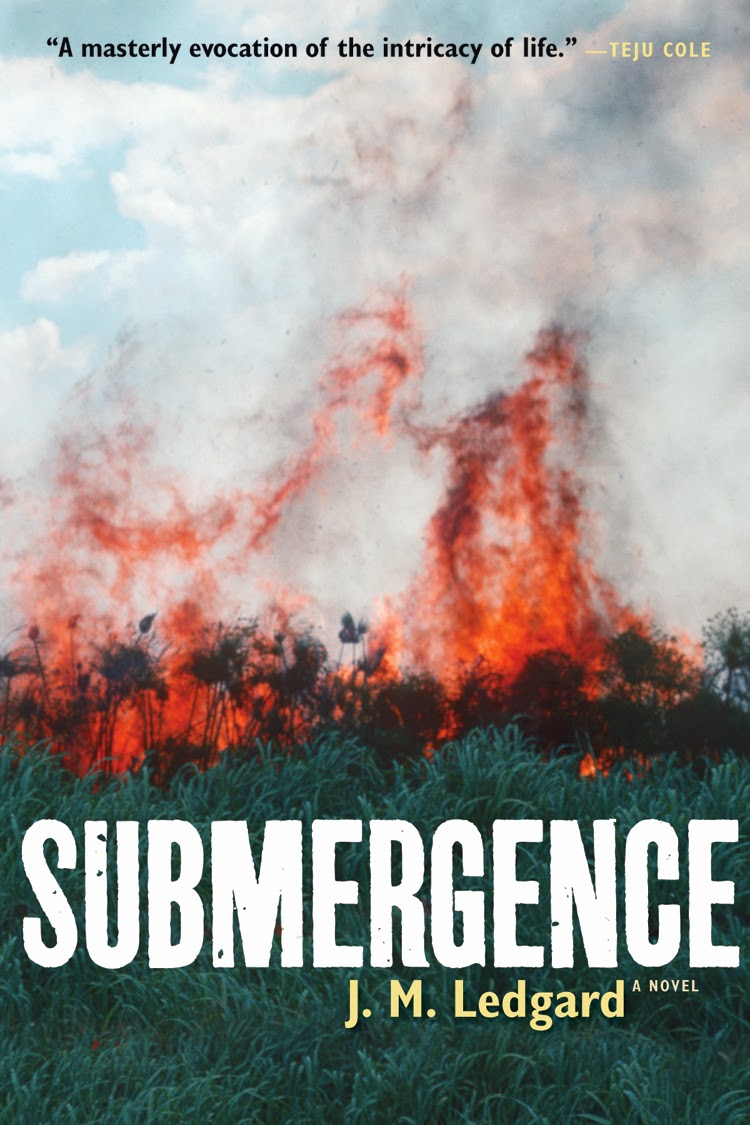
People ask, what kind of writer do you want to be. I say, I want to be like Brancusi . I want my writing to have that rigour, that beauty, and that ability to see the world in a new way. —J.M. Ledgard Coffee House Press is one of the very few publishers whose books I will buy simply because Coffee House published them (another, in case you're curious, is Small Beer Press . Apparently, I am partial to publishers with beverages in their names). At this year's AWP conference , I happened to pass the Coffee House booth, and I was curious to see what was new. On a table at the front of the booth, J.M. Ledgard's Submergence grabbed by eye: a novel partially about events in East Africa, with a cover blurb by Teju Cole , published by Coffee House ... how could I resist? I could not. Life caught up with me, though, and I didn't have time to read the book until this week. I begin by writing about where and why I bought the book because I'm trying to stay specific an...

Reading In the Heart of the Country

Image
I create myself in the words that create me. — In the Heart of the Country I've recently completed a draft of a paper on J.M. Coetzee's second novel, In the Heart of the Country , writing about the book and its contexts (with regard to trauma theory and Afrikaner Nationalism), but as I read various scholarly analyses of it, as well as reviews of the novel when it was first published, what struck me was the book's relative neglect compared to Coetzee's other novels, and the general lack of enthusiasm for it. When I first read it some years ago, I found it befuddling and often tedious. But it stuck with me, even haunted me, and that's why I decided to take some time digging into it. Older now, more experienced in reading Coetzee, I found it immensely rich and a powerful reading experience. Though I've spent a few months reading and re-reading it closely, I still feel like I'm only beginning to get a grasp of all it's up to. It is impossible to s...

Mandela

Image
11 February 1990 I was 14 years old on the day Nelson Mandela walked out of prison. I remember the television I watched it on, the room I was in, the couch I sat on. I was a white kid in rural New Hampshire, and I remember being overwhelmed with inexpressible hope, inchoate happiness. * I knew that there was widespread interest in the anti-apartheid struggle in South Africa, in the United States of America, but to see that reflected in the conduct of the people when I arrivedd in New York was something very encouraging, very inspiring. The excitement of the people, the remarks they made which indivated unwavering solidarity with our struggle — in the street, in buildings, offices and resident ... flats — it was just amazing; it swept me from my feet completely ... To know that you are the object of such goodwill makes one humble indeed. And that is how I felt. —Nelson Mandela: Conversations with Myself p. 377 * Mandela's death yesterday was certainly no surprise — ...

Zulu by Caryl Férey

Image
This review originally appeared in the print edition of  Rain Taxi   in the fall of 2010 . I didn't realize until I read this post at Africa is a Country that the book was being made into a film starring Forrest Whitaker and Orlando Bloom. I wrote as restrained and fair a review as I could; I hated the book. But since the movie is coming out, perhaps this review is of interest. ZULU Caryl FĂ©rey Europa Editions ($15) French writer Caryl FĂ©rey's Zulu isn't likely to win any awards from the South African Department of Tourism, for though the novel is as full as a guidebook with information about the country's history and culture, the story it tells is a relentlessly brutal one, and the South Africa that emerges from the narrative is a place of chaotic violence, rampant drug traffic, densely-populated slums rife with doom and disease, and corruption bursting from every level of society. The novel is a police procedural portraying an investigation into ...

A Decade of Archives 7: 2006

Image
This is the seventh in a series of posts leading up to this blog's tenth anniversary on August 18. In each post, I look back on one year, sometimes specifically and sometimes generally. All the posts can be found  here . Miami Vice K: There are times when I'd really love to live in your world. M: It's full of existential crises, but not a lot of headaches. K: I've already got the existential crises, so it might be a nice change. M: There's a reason the first album that ever made a strong impression on me was Stop Making Sense . K: So that's your aesthetic credo? M: No, I don't have a credo. It's just something I thought of and so I said it. It's probably not even true. —"A Conversation After Miami Vice " 2006 seems to me an ideal year of The Mumpsimus, not because all of the posts are high quality (they aren't!) but because the diversity of posts covers just about everything I think of as Mumpsimusian. In other years, th...

Black Star Nairobi by Mukoma wa Ngugi

Image
Last year, I wrote about Mukoma wa Ngugi's  Nairobi Heat , seeing it as an interesting, if flawed, first novel. Now Melville House has released Mukoma's second novel, a sequel to the first: Black Star Nairobi , a political thriller that begins as a detective story and ends up taking us from Kenya to Mexico to the U.S. and then back to Kenya at the time of the election crisis of 2007/08 . The writing in Black Star Nairobi  is more assured than in Nairobi Heat , and the plot and structure are more ambitious. The ambition is also the novel's curse, because the text is not up to the task of portraying and dramatizing the richness of its worlds and ideas — it's a book that needs to be twice its length or half its plot.

Some Writing About What We Wrote About When We Wrote About The Caine Prize

Image
Though I decided at the last minute not to join the third annual Caine Prize Blogathon after having  participated in the first two, I am still interested in the Prize, its effect(s), and its complex relationship to the idea of "African literature". Thus, I read with great interest an article about recent reactions to the Caine Prize that has been published in the latest issue of the venerable journal Research in African Literatures . The article, "The Caine Prize and Contemporary African Writing" by Lizzy Attree , includes a discussion of the first year of the Caine Prize blogathon, a discussion which at first was very exciting for me, because it's nice to have an endeavor you've participated in noticed. Once I actually read all of what Attree had written, though, I became annoyed. The trouble is, I don't really recognize  the actual discussion  in the discussion that Attree says we had. Or, rather, I recognize parts of it, but because Attree foc...

Achebe

Image
Chinua Achebe, 1930-2013 It's going to take me a while to have anything coherent to say about Chinua Achebe now that he has died. Not just because he was a great writer — and he was a great writer, as Aaron Bady says, "full stop" . But because, right now at least, I can't think of a more deeply influential writer in our era. Not just for Things Fall Apart , though that book certainly did a lot. But for so much else — his work as an editor for the African Writers Series , his essays on Conrad, his championing of Amos Tutuola after Tutuola's work had gone out of fashion, etc. etc. (If you ever needed evidence of the irrelevance of the Nobel Prize for Literature, the fact that Achebe never won it is Exhibit A.) The best writing I've seen so far on Achebe in the wake of his death comes from Keguro Macharia. You should read the whole, beautiful essay, but here is a taste: His departure now – euphemism must be used, if only once – feels much like an encou...

"Bombay's Republic" Wins the Caine Prize

According to the Caine Prize on Twitter , the winner of this year's award is Rotimi Babatunde for "Bombay's Republic". You can read the story as a PDF via the Prize website. It was the first of this year's nominees that I wrote about as part of the Caine Prize Blogathon, and my post also has links to other bloggers' (quite varied) takes on the story. It was certainly among the top of the stories for me, though I'm glad I didn't have to make the choice, as this year's group of nominees was generally impressive overall . Congratulations to everyone involved!

Catching Up with the Caine Prize

Image
This is my fourth post for the great 2012 Caine Prize blogathon. (See my first post for some details.) With 2 stories remaining for our Caine Prize Blogathon of Wonder, I fell behind. Thus, this post will be about the last two stories, "La Salle de Départ" by Melissa Tandiwe Myambo and "Hunter Emmanuel" by Constance Myburgh . Both are solid stories with their own virtues and are, much to the jurors' credit, utterly different from each other.

Blogging the Caine Prize 2012: "Urban Zoning"

This is my second post for the great 2012 Caine Prize blogathon. (See my first post for some details.) I'm coming a little late to Billy Kahora's story "Urban Zoning" (PDF) because it was finals week at one school where I teach and the last week of classes at another, so I haven't had much spare time, and then when I did finally start writing this it kept growing, and I disagreed with myself frequently, and I couldn't make anything cohere, and finally I gave up and just tried to salvage some of the maelstrom of questions and doubts that plagued me as I wrote. There are some thorough and excellent posts about this story up now, so I highly recommend following some of the links to them, which this week I will put first rather than last, because really if you do want to know about the story, you should read those... Other writers' posts about "Urban Zoning" by Billy Kahora: Black Balloon Stephen Derwent Partington The Reading Life Backslas...

Blogging the Caine Prize 2012: "Bombay's Republic"

Image
This is my first post in this year's Caine Prize for African Writing blogathon, organized by the ever-awesome Aaron Bady ( Zunguzungu ). Our participant numbers have grown exponentially this year, which is very exciting. If you don't remember from last year , the basic idea is that a bunch of us bloggery people write weekly posts about each of the short stories nominated for the Caine Prize, so helpfully provided in PDF form to anyone who wants to read them at the Caine Prize website . We will do our best to keep our posts updated with links to each others' posts, creating a giant hyperlinked conversation. The virtues of this are many — none of us feels obliged to be comprehensive about the stories, there's the potential for extremely different viewpoints to be offered, and, no matter what, a bunch of people are writing and reading about African short fiction. I'll post the links so far at the end of this post, and keep it updated as more appear over the next fe...

A Good Sign for the Caine Prize?

I've voiced my qualms about the Caine Prize for African Literature before, particularly in terms of the stories that often end up winning the award, and so I found this statement by this year's Chair of Judges, Bernardine Evaristo , encouraging: I’m looking for stories about Africa that enlarge our concept of the continent beyond the familiar images that dominate the media: War-torn Africa, Starving Africa, Corrupt Africa — in short: The Tragic Continent. I’ve been banging on about this for years because while we are all aware of these negative realities, and some African writers have written great novels along these lines (as was necessary, crucial), isn’t it time now to move on? Or rather, for other kinds of African novels to be internationally celebrated. What other aspects of this most heterogeneous of continents are being explored through the imaginations of writers? I don't think there's anything inherently wrong with individual Tragic Continent stories — I ...

The White Savior Industrial Complex

Image
Teju Cole: The White Savior Industrial Complex is not about justice. It is about having a big emotional experience that validates privilege. See also Aaron Bady's excellent collection of reading material:  "On the genre of 'Raising Awareness about Someone Else’s Suffering'" .

Nairobi Heat by Mukoma wa Ngugi

Image
I read Mukoma wa Ngugi's Nairobi Heat (part of Melville House's International Crime series) a few weeks ago, but haven't had the time to write much about it, so what I say here is likely to be more general than it would have been before. Though I think the novel has some significant flaws, those flaws are mitigated, for me at least, by a number of real strengths, and in the weeks since finishing it, moments from the novel have scratched through my thoughts and memory. For that reason, I think it's a book well worth reading. First, to get unpleasantness out of the way, here's what I see as the novel's flaws: Events often feel like they exist for the sake of the plot's convenience and not for any reason organic to the narrative; some moments that should evoke an emotional connection from readers are not set up in a dramatic way that would allow such emotion to come to the surface and are instead sped through (a particular fault in the romantic relation...

Report Realism

At Gukira, Keguro has posted some provocative thoughts on "report realism" in Kenyan fiction : Over the past 15 years and more specifically the past ten years or so, Kenyan writing has been shaped by NGO demands: the “report” has become the dominant aesthetic foundation. Whether personal and confessional or empirical and factual or creative and imaginative, report-based writing privileges donors’ desires: to help, but not too much; to save, but not too fast; to uplift, but never to foster equality. One can imagine how these aims meld with traditional modes of realism and naturalism and also speak to modernist truncations and postmodern undecidability. However, report realism names a more historically accurate way to name a genre indebted (very literally) to NGOS in Kenya. The report aesthetic goes beyond citing NGO facts and figures. It is concerned, above all, with a search for truth and accuracy and is threatened by imaginative labor. I cannot comment on the specific a...