Posts

Showing posts with the label Emily Dickinson

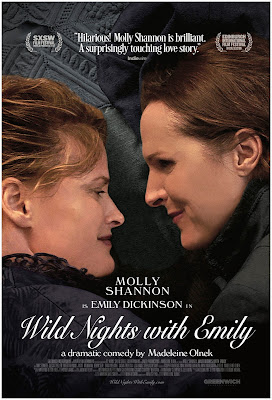
Wild Nights with Emily
Image
A few years ago, I declared a movie about Emily Dickinson, A Quiet Passion , to be "one of the worst movies I've ever seen". It remains so. Madeleine Olnek's Wild Nights with Emily  is everything A Quiet Passion  is not: lively, irreverent, joyfully artificial, poetic without being "Poetic", exuberantly cinematic, intentionally funny, and, in the end, quite moving. And while it is occasionally anachronistic, frequently campy, definitely uninterested in nuanced (or balanced) (or even fair) portraits of historical figures, and sometimes just flat-out bonkers, it's also a bit more accurate to Dickinson's actual life — and vastly more accurate to her legacy — than A Quiet Passion  was. But Wild Nights with Emily  is more than a biopic. It's a movie about literary history, about how stories of writers (and artists of all sorts) get told and received. It says that even with truths in plain sight, most people prefer legends, because legends are ...
A Quiet Passion

Image
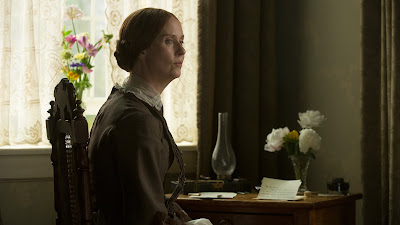
Few cinematic genres are as consistently awful as the biopic. Many of the greatest filmmakers have avoided any temptation to enter that genre, and the ones that, for reasons of finances or temporary insanity, did give it a shot usually ended up creating some of their worst films. (Mike Leigh is one of the few great filmmakers to have also created great biopics with Topsy-Turvy  and Mr. Turner .) Biopics of writers are especially hazardous. Most writers, after all, aren't as cinematic in their lives as Hunter S. Thompson or William S. Burroughs . Making the highly interior work of writing into something cinematically interesting is a nearly insuperable challenge, a challenge that usually results in Romantic clichĂ© and general absurdity. Which brings me to Terence Davies' latest film, A Quiet Passion , a biopic of Emily Dickinson , a writer with perhaps the least cinematic life of them all. I am fascinated by Dickinson's poetry, but I'm not a Davies acolyte...

"Everything is contingent, of course, on what you take yourself to be."

Image
From "James Baldwin, The Art of Fiction No. 78" at The Paris Review: INTERVIEWER You read contemporary novels out of a sense of responsibility? BALDWIN In a way. At any rate, few novelists interest me—which has nothing to do with their values. I find most of them too remote for me. The world of John Updike, for instance, does not impinge on my world. On the other hand, the world of John Cheever  did  engage me. Obviously, I’m not making a very significant judgment about Updike. It’s entirely subjective, what I’m saying. In the main, the concerns of most white Americans (to use  that  phrase) are boring, and terribly, terribly self-centered. In the worst sense. Everything is contingent, of course, on what you take yourself to be. INTERVIEWER Are you suggesting they are less concerned, somehow, with social injustice? BALDWIN No, no, you see, I don’t want to make that kind of dichotomy. I’m not asking that anybody get on picket lines or take p...