Posts

Showing posts with the label essays

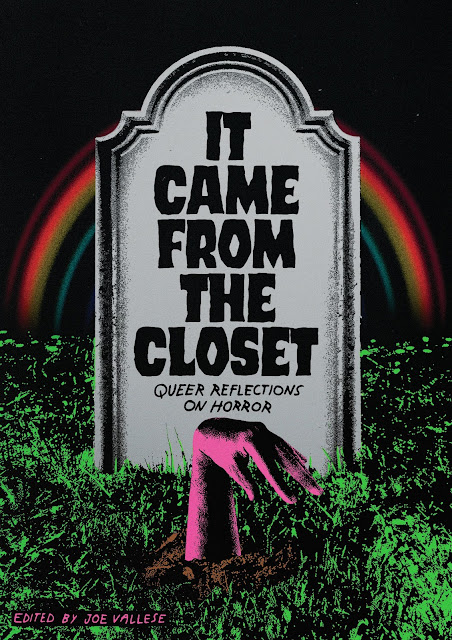
Normality Is Monstrous: On It Came from the Closet: Queer Reflections on Horror
Image
  In the introduction to It Came from the Closet , editor Joe Vallese describes the book as “a collection of eclectic memoirs that use horror as the lens through which the writers consider and reflect upon queer identity, and vice versa.” This is accurate, but not quite specific enough. It Came from the Closet is a collection of twenty-five short personal essays in which queer people remember horror movies that, in many cases, they saw when they were children or young adults—formative years for everyone, but differently formative for people whose sense of self and whose budding desires conflict with those most valorized by society and popular culture. The writers are diverse in identities and backgrounds, and the films that serve as touchstones or anchors for the essays are also varied (within the scope of being horror movies): from Godzilla and Jaws to Get Out and Hereditary to lesser-known movies such as the Cuban psychological thriller ¿Eres tu, papa? ( Is That You? ) and ...

The Rats in Our Walls

Image
  It began as a blog post. I was just going to write here some quick thoughts about H.P. Lovecraft's 1924 story "The Rats in the Walls" and how the narrator made me think about people who've lost their brains to QAnon conspiracies.  Then I couldn't help thinking about the concept of degeneracy, and of eugenics, and of Madison Grant, a name once famous and now forgotten, literally erased from the archives. I returned to a book I had read a decade or more ago, Jonathan Spiro's excellent Defending the Master Race: Conservation, Eugenics, and the Legacy of Madison Grant , a book that explains so much about the United States, popular ideas of science, the troubled history of environmentalism, and, in its own way, people like H.P. Lovecraft.  And then I wondered if maybe we ought to see Lovecraft's narrators as deeply unreliable rather than as visionaries. What if Lovecraft's fiction is a testimony to yearning as much as to horror, and what if the yearnin...

Asterisks for Dead Astronauts

Image
At my author website, I've published an essay titled "Asterisks for Dead Astronauts". It is an exploration of reading, grief, poetry, the end of the world. It began as an essay about Jeff VanderMeer's recent novel Dead Astronauts and then ... sprawled. The essay has a lot in common with my recent post here on Kate Zambreno's Drifts , and, indeed, the post was deliberately meant as a kind of companion piece. (It doesn't matter the order you read them in, but I do think they benefit from each other.) I'm slowly working toward a new book project called Asterisks . I don't know that the form, shared between the two pieces, will hold for a book-length work, but the general concerns are ones I'm continuing to explore, and the style feels right, and adaptable. I wrote "Asterisks for Dead Astronauts" last fall, and it has gathered rejections from publishers since December. I'm tired of sending it out, and can't think of another publisher...

"After the End of the End of the World"

Image
My story "After the End of the End of the World" from the Fall 2019 issue of Outlook Springs is now available online. To call this a "story" as in "short story" as in "work of fiction" is not entirely accurate. It's much more of an essay about a novel I spent more than a decade, off and on, trying to write. I ended up enjoying writing this story far more than I ever enjoyed working on the novel. Here's how it begins: She was born to a father who wanted to take his anger out on the world, and in every story there is to tell about her, she escaped him, and the consequences were terrible, and she ends somewhere cold, somewhere north, on a glacier perhaps, a frozen place in an ever-warming world. It is not too much to say that her father destroyed her life. Who is to blame, though, for destruction? Who is to blame for life? I return always to the moment where she finds out what happened. Or, more accurately, I return to the moments before, ...

Orpheus in the Bronx by Reginald Shepherd

Image
This review appeared in the Spring 2008 issue of Rain Taxi . (I've left the page references in that RT uses for proofreading, as they may be useful to readers.) Orpheus in the Bronx: Essays on Identity, Politics, and the Freedom of Poetry by Reginald Shepherd University of Michigan Press It's not difficult to trace the source of all the magic in Reginald Shepherd's first collection of essays—the author's sensitivity to the fruitful borderlands between aesthetics and politics—but pinning down each wondrous effect emanating from that source might take a while.   This is a book rich with ideas and implications, a book that provokes and dazzles and sings. In the introduction to Orpheus in the Bronx , Shepherd calls himself "someone who has looked to art and literature as a means for the expansion rather than the constriction of horizons" (1), and that tendency and quest is evident on every page of every essay.   As a poet who is, among other thin...

Speculative Memoir

Image
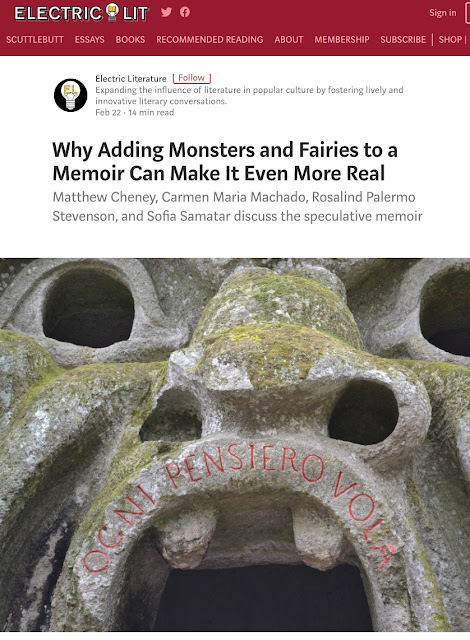
Electric Literature  has now published a roundtable discussion between Sofia Samatar, Carmen Maria Machado, Rosalind Palermo Stevenson, and me about a thing we provisionally call "speculative memoir". This began when Sofia had separate conversations with us all over the last couple years about fiction in fact, the creative possibilities of nonfictional writing, the perils and possibilities of memoir, etc. She and I talked for a long time about it when I was first putting together ideas for my dissertation, and I've kept with quite a few of the ideas we originally discussed. (Perhaps no surprise, as my interest in the topic goes back a ways with one of the subjects of my dissertation, J.M. Coetzee.) And as someone who writes both fiction and nonfiction, the distinctions always interest me. Sofia also has a new book out, Monstrous Portraits , "an uncanny and imaginative autobiography of otherness", with drawings by her brother Del. Seek it out!

Selecting Woolf's Essays

Image
It is time for a capacious, authoritative one-volume selection of Virginia Woolf's essays and journalism. (Perhaps one is in preparation. I don't know.) The sixth and final volume of her collected essays was released in 2011. It is wondrous, as are all of the volumes in the series, but though it's a goldmine for scholars, the series isn't really aimed at the everyday reader; each volume is relatively expensive (though not to the extent of an academic volume, e.g. the Cambridge Editions ), and plenty of the material is ephemeral, repetitive, or esoteric. A one-volume Selected Essays  does exist, edited by David Bradshaw and published by Oxford World's Classics. It's better than nothing, but it's small and missing many of Woolf's best essays — including perhaps her single most-frequently-reprinted essay, "The Death of the Moth" . Bradshaw also slights Woolf's literary essays, perhaps because the two Common Reader  volumes remain in pri...

Reflections on Samuel Delany's Dark Reflections

Image
At the Los Angeles Review of Books , I have a new essay about Samuel R. Delany's 2007 novel Dark Reflections , which is about to be released in a new and slightly revised edition by Dover Books . Here's a taste: In many ways,  Dark Reflections  is a narrative companion to Delany’s 2006 collection of essays, letters, and interviews,  About Writing . In the introduction to that book, Delany says that its varied texts share common ideas, primary among them ideas about the art of writing fiction, the structure of the writer’s socio-aesthetic world both in the present and past, and “the way literary reputations grow — and how, today, they don’t grow.” The book is mainly, though not exclusively, aimed at aspiring writers. It provides some advice on craft, but it circles back most insistently to questions of value, and especially to questions of the difference between  good writing  and  talented writing  — and what it means, practically and materially, ...

Reality Affects

Image
Bonnie Nadzam's recent essay at Literary Hub , "What Should Fiction Do?" , is well worth reading, despite the title. (The only accurate answer to the question in the title [which may not be Nadzam's] is: "Lots of stuff, including what it hasn't done yet...") What resonates for me in the essay is Nadzam's attention to the ways reality effects intersect with questions of identity — indeed, with the ways that fictional texts produce ideas about identity and reality. I especially loved Nadzam's discussion of how she teaches writing with such ideas in mind. Nadzam starts right off with a bang: An artistic practice that perpetually reinforces my sense of self is not, in my mind, an artistic practice. I’m not talking about rejecting memoir or characters “based on me.” What I mean is I don’t have the stomach for art that purports to “hold up a mirror to nature,” or for what this implies, philosophically, about selfhood and the world in which we li...

Reading, Writing, and Living Through the AIDS Crisis

Image
Literary Hub has published one of the most personal essays I've ever written, an essay about growing up as a reader and person during the AIDS crisis. The original title, which doesn't make a good headline and so wasn't used, is "A Long Gay Book, A Life". (I'm always happy for a Gertrude Stein allusion. And quotation, as you'll see in the piece.) The piece is fragmentary, like memory. It roams across the page, probably an effect of my recently revisiting some of Carole Maso's writings. (Also, reading Keguro Macharia's elegant essays and blog posts .) Here's an excerpt: When I was in the eighth grade I wrote a story about a vampire. He was young, roughly my age, entering puberty, entering vampirism. He ached to touch, to kiss, to drink in the loveliness of what he hungered for, but to do so was to admit his monstrosity and to kill what he loved. He feared himself and hated himself. I don’t remember anything else about that story e...

"Perfect Day" at Cold Takes

Image
When Kelly J. Baker put out a call for essays about music albums and emotions, I knew immediately what I would propose: An essay about The The's Soul Mining  and what it meant to me as an adolescent. Now, that essay, "Perfect Day", is available on Kelly's site, Cold Takes . Here's the opening: That moment: album — book — car ride. How long ago now? Twenty-five years? Something like that. It was (roughly) sometime between 1988 and 1991, which means sometime between when I was (roughly) 12 years old and 16 years old. Most likely 1989 or 1990. Most likely 14 or 15 years old. Interstate 93 North between Boston, Massachusetts and Plymouth, New Hampshire. Blue Toyota Tercel wagon, my mother driving. Mass market paperback of Do Androids Dream of Electric Sheep by Philip K. Dick ( Blade Runner tie-in edition). Black Sony Walkman cassette player. Soul Mining by The The. read more

Thinking Back with Our Foremothers: For Jane Marcus

Image
It is far too early to tear down the barricades. Dancing shoes will not do. We still need our heavy boots and mine detectors. —Jane Marcus, "Storming the Toolshed" 1. Seeking Refuge in Feminist Revolutions in Modernism Last week, I spent two days at the Modernist Studies Association conference in Boston. I hadn't really been sure that I was going to go. I hemmed and hawed. I'd missed the call for papers, so hadn't even had a chance to possibly get on a panel or into a seminar. Conferences bring out about 742 different social anxieties that make their home in my backbrain. I would only know one or maybe two people there. Should I really spend the money on conference fees for a conference I was highly ambivalent about? I hemmed. I hawed. In the end, though, I went, mostly because my advisor would be part of a seminar session honoring the late Jane Marcus , who had been her advisor. (I think of Marcus now as my grandadvisor, for multiple reasons, as will be...

Dragons!

Over at Press Play, I have a new text essay to accompany Leigh Singer's video essay on dragons in movies. Here's a taste: In confronting dragons, humans confront an ancient, alien Nature. Unlike the other popular fantasy figures these days—vampires and zombies—dragons are not transmuted humans, but rather something beyond us, other than us. Often, they are represented as deeply greedy, and this is their fatal flaw (e.g. Smaug in The Hobbit ). They guard, hoard, and covet. Within most fantasy stories, they're part of a medieval environment and their greed stands in contrast to the commons. The triumph of the little human against the dragon is a heroic reappropriation of resources and a signal of the human ability to triumph over the hoard of Nature—the dragon must die for civilization to advance.  You can read the whole thing at Press Play .

The Guy Davenport Reader

Image
Guy Davenport; photograph by Jonathan Williams Counterpoint Press has just released The Guy Davenport Reader , edited by Davenport's literary executor,  Erik Reece . It's a good, basic overview of Davenport's work, and a nice opportunity to review some of the highlights of that work. Davenport was one of the greatest of American writers, and a single 400-page book can only offer a brief taste of his large and eclectic oeuvre , but it seems to me that the Reader  achieves what it sets out to achieve: to bring together various genres of Davenport's writing (fiction, essays, poetry, translations, journals), and, in Reece's words, "to make an argument for the extraordinary range and even, yes, the accessibility of this remarkable writer." Accessibility  is, of course, in the mind of the perceiver, and poses particular problems with Davenport's work, a fact that befuddled reviewers pointed out with every book he published. As a Rhodes Scholar, he wro...

"On Quitting": We Need New Forms

Keguro Macharia has written an essay titled "On Quitting" that I've now read three times since I first learned about it this morning. So much of its subject matter sits close to my heart, and thus so much of it is heartbreaking. I begin to wonder about the relationship between geo-history, the saturation of space with affect, and psychic health. I want to describe how I come to be here-now: another threshold I start writing a linear story, winding, but linear, about psychic health and academic production, a story that tries to make sense of why I am resigning from a tenure track job from a major research university at the same time as I am completing a book manuscript for publication. Not only resigning but also changing continents, returning to a place I have not called home for a very long time. This, I realize, is a story about words and places. So let me start with the word that started it, or named its fractures. As you can see from that little excer...

"Stories in the Key of Strange"

Image
A not-strictly-new new piece of mine has just been posted at Weird Fiction Review , "Stories in the Key of Strange: A Collage of Encounters" . It's not-strictly-new because the collage is built from excerpts from things I've written over the past few years: blog posts, interviews, book reviews, Strange Horizons columns, stray essays. When the good folks at WFR asked me to contribute, I was up to my neck in grading student papers, etc., and though I wanted to contribute, I didn't have a spare brain cell to spend on something new. I thought putting together a collage would be an interesting exercise and easier than writing a new piece. It was definitely the former, but not the latter — I forgot how much I've written over the years... (Plenty of it is best left forgotten.) Trying to organize it all in some vaguely coherent and resonant way was a fun challenge, although I'm too close to it all to know if it's at all effective. At the very least, it...

Chaos Cinema

Image
Scarface, 1932 There's an interesting two-part video essay by Matthias Stork posted at Press Play about what Stork calls "chaos cinema" -- action movies (mostly from the last 15 years or so) that violate classical principles of staging, framing, and cutting. I am in sympathy with Stork's overall point, and one of my few absolutely fuddy-duddy tendencies is a belief that classical action composition and editing is usually superior to the chaos cinema style Stork identifies -- I often want to yell at directors like Christopher Nolan  (who is five years older than me), "You kids will never understand why Howard Hawks is great!" But I have some reservations about Stork's analysis. Basically, they are two: 1.) He interprets an aesthetic technique as a single type of moral expression; 2.) he assumes all audiences watch the way he does.

Of Essays and Norton Readers

Image
The ever-extraordinary Anne Fernald has just put up a post asking for recommendations of essays , since she is on the advisory board for The Norton Reader and they're planning a new edition. I have an extraordinary fondness for The Norton Reader , though some of that fondness is, as they say, extra-textual. The textual fondness is that I think it's a wonderfully generous selection of stuff -- in fact, I like it so much I've assigned the book in classes, and if I ever taught such a class again, I'd almost certainly use it again. The extra-textual fondness is entirely for John C. Brereton , one of the main editors of the book, who, almost exactly one year ago, had the excellent taste to marry one of my best friends and mentors. So I care a lot about The Norton Reader . And I like essays. Thus, while my students were taking tests this afternoon, I thought about essays to recommend to the folks at the NR. My thoughts are all a-jumble on this topic, though, because I har...

Rick Bowes on Stonewall at 40

Image
Knowing Rick Bowes is a privilege for many reasons, but one of my favorites is that he is a wonderful historian of New York City. Walking the streets with Rick becomes a magical tour through the wondrous and terrible changes the city has seen over the centuries. Having lived in Manhattan for most of his life, Rick has also sometimes been an eyewitness to history, including the history made in the early hours of June 28, 1969 in Greenwich Village: The Stonewall Riots . Richard Bowes is the author of such books as Minions of the Moon , From the Files of the Time Rangers , and Streetcar Dreams . He has won the World Fantasy Award, the International Horror Guild Award, the Lambda Literary Award, the Million Writers Award, and been nominated for the Nebula Award. He reportedly likes writing but hates being a writer . via Wikimedia Commons In History's Vicinity by Richard Bowes It's odd to be old enough to remember history. The Stonewall Riot always makes me feel like...

HPL in NER

Image
When we were working on the first volume of Best American Fantasy , I said to Jeff and Ann that I wished we could reprint some nonfiction, because some of the most wondrous things I'd encountered were essays. I had New England Review at the forefront of my mind when I said this, because I sit down and read each issue that arrives immediately, and most of what excites me is the eclectic nonfiction they publish (which is not to say the poems and stories they publish are not exciting, too; many are, and I've passed some on to Ann and Jeff. Yes, we're still working on BAF 2, the "patience is a virtue" edition...) The latest issue of NER contains an essay by J.M. Tyree, "Lovecraft at the Automat". It's not an essay that will offer too much that's new to a Lovecraft devotee, I expect, but I'm only a casual Lovecraftian, and generally more interested in his life and circumstances than in his writing. It's fun, though, to see a journal lik...