Posts

Showing posts with the label Delany

Modernist Crisis and the Pedagogy of Form

Image
My new book Modernist Crisis and the Pedagogy of Form: Woolf, Delany, and Coetzee at the Limits of Fiction is now available from Bloomsbury Academic. I don't mind if you don't buy it. The retail price is absurd. This hardcover is aimed at the academic library market, even though academic libraries (at least the ones I know) have shrinking book budgets. I've been told that in 12-18 months, a less expensive paperback will be released (though by "less expensive", something in the range of $40 is probably what we can expect — a price higher than the average trade hardcover). There is an ebook edition, but it's currently going for $99 at Amazon; Bloomsbury will sell you an ePub or PDF for $79.20. Those prices for an ebook are not ones anybody I've ever met would pay, and indicate a publisher that doesn't want people to buy ebooks. I don't point out the absurd prices because I am mad at Bloomsbury. I've had an excellent experience with them, ...

Orpheus in the Bronx by Reginald Shepherd

Image
This review appeared in the Spring 2008 issue of Rain Taxi . (I've left the page references in that RT uses for proofreading, as they may be useful to readers.) Orpheus in the Bronx: Essays on Identity, Politics, and the Freedom of Poetry by Reginald Shepherd University of Michigan Press It's not difficult to trace the source of all the magic in Reginald Shepherd's first collection of essays—the author's sensitivity to the fruitful borderlands between aesthetics and politics—but pinning down each wondrous effect emanating from that source might take a while.   This is a book rich with ideas and implications, a book that provokes and dazzles and sings. In the introduction to Orpheus in the Bronx , Shepherd calls himself "someone who has looked to art and literature as a means for the expansion rather than the constriction of horizons" (1), and that tendency and quest is evident on every page of every essay.   As a poet who is, among other thin...

Writing in Crisis

Image
I prefer, where truth is important, to write fiction.  —Virginia Woolf, The Pargiters Preface [update December 2018] The embargo period for my dissertation has passed, and so it is now available via the University of New Hampshire Scholar's Repository. It seems my doctoral dissertation has hit the ProQuest dissertations databases, so now is perhaps a useful time to say a few words about it here. First, the details for finding it, since there doesn't seem to be an openly accessible link: The title is  Lessoning Fiction: Modernist Crisis and the Pedagogy of Form , and it is Dissertation/thesis number 10786319 and ProQuest document ID 2056936547. (If you don't have access to any of those databases and would like a copy of the manuscript, feel free to  email me  and I will send you a PDF.) Here's the abstract: Writers committed to Modernist ideas of artistic autonomy may find that commitment challenged during times of socio-political crisis. Thi...

Delany at 75

Image
from The Polymath Samuel R. Delany just celebrated his 75th birthday, an auspicious occasion. I've been writing about Delany for over a decade now — I've written and published more about his work than about that of any other writer: introductions to new editions of The Jewel-Hinged Jaw , Starboard Wine , and The American Shore ; on his early pornographic novel Equinox ; on his recent novel Dark Reflections ; an interview in 2009 . I spent some time last summer researching in his archives at Boston University and expect to return this summer, as about a third of my doctoral dissertation (in progress...) is devoted to his work. I've given presentations about him at academic conferences, and all of my academic friends are probably quite tired of my invoking his name at every possible opportunity. The simple fact is that I think Delany is one of the most important American writers, one who ought to be spoken of alongside any great American writer (however defined or ...

Reflections on Samuel Delany's Dark Reflections

Image
At the Los Angeles Review of Books , I have a new essay about Samuel R. Delany's 2007 novel Dark Reflections , which is about to be released in a new and slightly revised edition by Dover Books . Here's a taste: In many ways,  Dark Reflections  is a narrative companion to Delany’s 2006 collection of essays, letters, and interviews,  About Writing . In the introduction to that book, Delany says that its varied texts share common ideas, primary among them ideas about the art of writing fiction, the structure of the writer’s socio-aesthetic world both in the present and past, and “the way literary reputations grow — and how, today, they don’t grow.” The book is mainly, though not exclusively, aimed at aspiring writers. It provides some advice on craft, but it circles back most insistently to questions of value, and especially to questions of the difference between  good writing  and  talented writing  — and what it means, practically and materially, ...

The Journals of Samuel R. Delany

Image
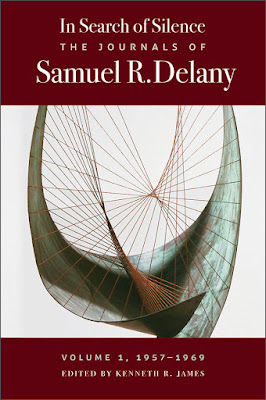
Kenneth James is editing the journals of Samuel Delany for publication. Volume 1 is coming out from Wesleyan University Press in December. For the future volumes, Ken needs help with funding. If you already know how valuable this project is, don't read on. Just go donate. But if you need some convincing, please read on...

Canonicity and an American Literature Survey Course

Image
This term, I taught an American literature survey for the first time since I was a high school teacher, and since the demands of a college curriculum and schedule are quite different from those of a high school curriculum and schedule, it was a very new course for me. Indeed, I've never even taken such a course, as I was successful at avoiding all general surveys when I was an undergrad. As someone who dislikes the nationalism endemic to the academic discipline of literature, I had a difficult time figuring out exactly what sort of approach to take to this course — American Literature 1865-present — when it was assigned to me. I wanted the course to be useful for students as they work their way toward other courses, but I didn't want to promote and strengthen the assumptions that separate literatures by national borders and promote it through nationalistic ideologies. I decided that the best approach I could take would be to highlight the forces of canonicity and n...

The American Shore by Samuel R. Delany from Wesleyan University Press

Image
Now available for pre-order. Here's the Wesleyan University Press page for it. Here's an excerpt from the introduction, should your appetite need whetting: It may, on a quick glance, appear to be a book about a short story. On further examination, it may appear to be a book about how science fiction works, or a contribution to the literary and cultural theory of its day. It is those things, but not only those things. Like so much of Delany’s writing, its strategies and concerns nudge our view wider. Much as the best science fiction’s trivalent discourse easily lures us into considering the meaning produced by the intersections of world and text, and thus provides a powerful space for reflection on both, so Delany’s dive over and between the lines of “Angouleme” stands as a model for and instigator of various levels of thought about all the signs and languages that produce and obscure our lives. No great text ever ends if there are still readers to read it and re-read it,...

Samuel R. Delany: Another Roundtable

Image
Recently, Locus published an online discussion of the work of Samuel R. Delany with a bunch of different writers and critics, primarily aimed at discussing Delany’s status as the newly-crowned Grand Master of the Science Fiction Writers of America . Plenty of interesting things are said there, and the participants include a number of people I’m very fond of (both as writers and people), but the particular focus ended up, I thought, creating a certain narrowness to the discussion, especially regarding the post- Dhalgren works, and I thought it might be nice to gather a different group of people together to discuss Delany … differently. So here we are. I put out the call to a wide variety of folks, and this is the group that responded. We used a Google Doc , and the discussion grew rhizomatically more than linearly, so you'll see that we sometimes refer to things said later in the roundtable. (This makes for a richer discussion, I think, but it may be a little jarring ...

Samuel Delany: The E-books

Image
Today, Open Road Media releases e-book editions of a number of Samuel R. Delany's best books . I've had the chance to look at the Kindle edition of Dhalgren , and it's really excellent. Indeed, it looks to be the most accurate text, incorporating the corrections to errata in the Vintage editions , which were, until now, the most accurate. The other Open Road editions (which I haven't yet seen) are: Babel-17 , Nova , Stars in My Pocket Like Grains of Sand , The Motion of Light in Water , and the four NevèrĂ¿on books.

A Decade of Archives 8: 2005

Image
This is the eighth in a series of posts leading up to this blog's tenth anniversary on August 18. In each post, I look back on one year, sometimes specifically and sometimes generally. All the posts can be found  here . 2005 was a big year around these here parts, as the blog was nominated for a World Fantasy Award. I went to the World Fantasy Convention and wrote up a report of that experience here. It was an exciting time. From my perspective now, though, 2005 doesn't seem like all that great a year for actual blog posts,. There are lot of them — 2005 is second only to 2004 in the number of individual posts — but most of them are quick links, bits of news, etc. The stuff that I now will just throw on Twitter , or ignore altogether. This is reassuring, actually, because I often look back on the number of posts in 2005 and 2004 with fondness and even a certain awe — how did I ever write so much? (My life was no less busy and crazy back then; indeed, it was busier and...

A Decade of Archives 7: 2006

Image
This is the seventh in a series of posts leading up to this blog's tenth anniversary on August 18. In each post, I look back on one year, sometimes specifically and sometimes generally. All the posts can be found  here . Miami Vice K: There are times when I'd really love to live in your world. M: It's full of existential crises, but not a lot of headaches. K: I've already got the existential crises, so it might be a nice change. M: There's a reason the first album that ever made a strong impression on me was Stop Making Sense . K: So that's your aesthetic credo? M: No, I don't have a credo. It's just something I thought of and so I said it. It's probably not even true. —"A Conversation After Miami Vice " 2006 seems to me an ideal year of The Mumpsimus, not because all of the posts are high quality (they aren't!) but because the diversity of posts covers just about everything I think of as Mumpsimusian. In other years, th...

Recent Reading

Image
Blogging always slows to a crawl during the second half of a semester, but I was surprised to see that it's been almost a month since I last posted here. Egads. I've hardly had a moment to breathe, though. For now, I just want to capture a few moments of reading from the recent weeks.

Starboard Wine at Strange Horizons

Strange Horizons has just posted a review by T.S. Miller of the new edition of Samuel Delany's Starboard Wine , for which I wrote an introduction . It's a generally thoughtful and well-informed review; inevitably, I have quibbles with it, but they aren't important — what's important is that, as Miller notes, the book is now available to a wider audience than ever before.

Nonfiction and Science Fiction

Image
There's a fun Mind Meld feature at SF Signal on "Non-Fiction Books About Science Fiction That Should Be In Every Fan’s Library" , with responses from an eclectic group of writers, scholars, reviewers, etc. Well worth a glance. My own prejudices and inclinations align enough with many of the respondents that their lists include a lot of books I've spent a lot of time with, as well as others I'm unfamiliar with, which is always fun. One of the good things the Mind Meld editors do a lot is create agonizingly broad questions that can elicit hugely varied responses depending on how people interpret them; that's part of the fun of the feature. In this case, Gary Wolfe nails it: "I think this question depends on what you mean by 'fan.' Not all fans set out to be students of SF; some just want to enjoy the stuff and have no more interest in finding out about it than in finding out where their sausage comes from. Still fewer aspire to be scholars of th...

Delany & The Bat

Ed Champion interviews Samuel Delany for his Bat Segundo Show. An informed, wide-ranging conversation that's very much worth the time to listen to: Delany: And I think pornotopia is the place, as I’ve written about, where the major qualities — the major aspect of pornotopia, it’s a place where any relation, if you put enough pressure on it, can suddenly become sexual. You walk into the reception area of the office and you look at the secretary and the secretary looks at you and the next minute you’re screwing on the desk. That’s pornotopia. Which, every once in a while, actually happens. But it doesn’t happen at the density. Correspondent: Frequency. Delany: At the frequency that it happens in pornotopia. In pornotopia, it happens nonstop. And yet some people are able to write about that sort of thing relatively realistically. And some people aren’t. Something like Fifty Shades of Grey is not a very realistic account. Correspondent: I’m sure you’ve read ...

Libidinal Estrangement

Image
From a rich, insightful, and fascinating review by Roger Bellin of Samuel Delany's Through the Valley of the Nest of Spiders : It is certainly possible to find worthwhile the effort it takes to attempt the broadening of one's libidinal sympathies — the way a psychologically realistic novel can demand our sympathy with someone else's life and thoughts, this one demands our sympathy with his sexual desires. If science fiction, in Darko Suvin's definition, is the genre of "cognitive estrangement," then the pornographic first half of TVNS is a work of libidinal estrangement: the novel's alienating effect bears on its reader's desires, not his rational mind. [...] Rather than just cataloguing its protagonists' sex acts, TVNS gradually becomes a psychologically complicated novel about what they've learned from them — a reflection, through a host of little narrated daily incidents, on the ethical lessons that a life of joyous perversion ha...

Worldbuilding

Image
From three of the most interesting things I've read recently and, thus, started thinking about together... M. John Harrison: A world can be built in a sentence, but epic fantasy doesn’t want that. At the same time, it isn’t really baggy or capacious, like Pynchon or Gunter Grass. It has no V . It has no Dog Years . It has no David Foster Wallace. It isn’t a generous genre. The same few stolen cultures & bits of history, the same few biomes, the same few ideas about things. It’s a big bag but there isn’t much in it. With deftness, economy of line, good design, compression & use of modern materials, you could ram it full of stuff. You could really build a world. But for all the talk, that’s not what that kind of fantasy wants. It wants to get away from a world. This one. Ian Sales on Leviathan Wakes  by James S.A. Corey: There are some 150 million people living in the Asteroid Belt. The greatest concentration is six million in the tunnels inside the dwarf planet ...

"Why We Oppose Pockets for Women"

Here's a fabulous article by Lili Loofbourow from The Hairpin that presents excerpts from a book she discovered on Project Gutenberg, Are Women People?   It's full of awesomeness, but the Delany-ologist in me particularly liked this bit about pockets: Why We Oppose Pockets for Women by Alice Duer Miller 1. Because pockets are not a natural right. 2. Because the great majority of women do not want pockets. If they did they would have them. 3. Because whenever women have had pockets they have not used them. 4. Because women are required to carry enough things as it is, without the additional burden of pockets. 5. Because it would make dissension between husband and wife as to whose pockets were to be filled. 6. Because it would destroy man's chivalry toward woman, if he did not have to carry all her things in his pockets. 7. Because men are men, and women are women. We must not fly in the face of nature. 8. Because pockets have been used by men to carry ...

About (Experimental) Writing

...having the entire intellectual armamentarium of rhetorical devices at your beck and call is far preferable to having to limit yourself to tradititional narrative tropes, when writing about truly important matters. To me, that's just simple logic.  —Samuel R. Delany (see also, here )