Posts

Showing posts with the label Chekhov

Alice Munro at 90

Image
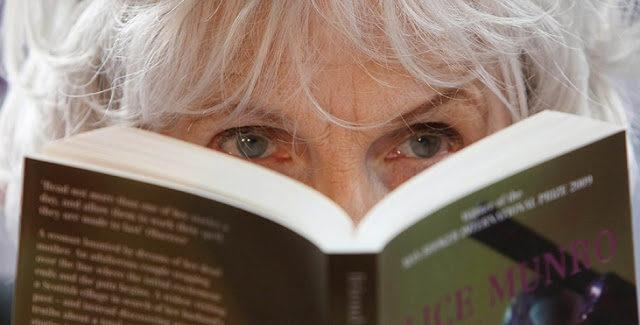
Today is Alice Munro's 90th birthday, and her singular, extraordinary career deserves great celebration.  Munro's first published story, "The Dimension of Shadow" , appeared (under her name at the time, Alice Laidlaw) in the April 1950 issue of the student literary magazine of the University of Western Ontario, Folio . According to Alice Munro: Writing Her Lives by Robert Thacker, she soon began sending her stories to Robert Weaver ( "the best friend the Canadian short story ever had" ), who ran a radio series on the CBC devoted to Canadian short stories; after rejecting a few, Weaver broadcast a reading of "The Strangers" on October 5, 1951. Weaver encouraged her to keep writing and to submit her work to literary journals. Her first professional appearance in print was with "A Basket of Strawberries" in Mayfair magazine's November 1953 issue. Her first collection, Dance of the Happy Shades , was published in Canada in 1968, in the...

Anton Chekhov's Selected Stories: A Norton Critical Edition edited by Cathy Popkin

Image
My name is Matthew and I am a Norton Critical Edition addict. Hardly a term has gone by without my assigning students at least one NCE, both when I was a high school teacher and especially now that I'm teaching college students. (This term, it's The Red Badge of Courage .) I have been known to change syllabi each term just to try out new NCEs with students. I have bought NCEs for myself even of books that I already owned in multiple other editions. I have all four editions of the NCE of Heart of Darkness because the changes between them fascinate me. (I've been meaning to write a blog post or essay of some sort about those changes. I'll get to it one day.) Anton Chekhov is my favorite writer, a writer whose work I've been reading and thinking about for all of my adult life. The Norton Critical Editions of Chekhov's stories and plays published in the late 1970s remained unchanged until Laurence Senelick's Selected Plays came out in 2004, and then, f...

A Decade of Archives 9: 2004

Image
This is the ninth in a series of posts leading up to this blog's tenth anniversary on August 18. In each post, I look back on one year, sometimes specifically and sometimes generally. All the posts can be found  here . 2004 was the first full year of The Mumpsimus. It was also the year with the largest number of posts: 319. (These days, I'm able to get out about 100 or so in a year.) And it was the year when a relatively large number of people began to notice what was going on here. That initial attention is what made me think this was not, perhaps, just a useless lark. A lark, yes, and largely useless, yes, but maybe not completely so... The year began with a post about returning : I hadn't paid a lot of attention to the site at the end of 2003, having written one post in December and none in November. The first paragraph of that post indicates that I was still thinking of this as a site about, primarily if not exclusively, science fiction. The reason for my absence...

World on a Wire Update, Plus Vanya

Image
Consumer-citizens of the United States, rejoice! Criterion has announced that they will be releasing Rainer Werner Fassbinder's wonderful science fiction epic World on a Wire in February. Diligent and obsessive readers of this here blog may remember that I swooned over World on a Wire both here and at Strange Horizons back in September, and I remain as swoonful toward it as before. The DVD/Blu-ray will include a 50-minute documentary about the film by Juliane Lorenz, one of Fassbinder's most frequent collaborators and the head of the Fassbinder Foundation . Lorenz has created documentaries for some of the other DVD releases of Fassbinder's films in the U.S. and elsewhere, and I've enjoyed all of the ones I've seen, so am looking forward to this one quite a bit. And in equally magnificent — indeed, perhaps even more  magnificent — news, Criterion will also be releasing Louis Malle's final film, Vanya on 42nd Street . It's one of my favorites, a ...

Alice Munro and the Case of the Chekhovian Dames

Image
[update: for some reason I originally attributed the New Republic article discussed below to Ruth Gordon rather than Ruth Franklin.] I adore (adore, I tell you!) the stories of Alice Munro, as anybody who's looked at my bookshelves can attest, and I adore (adore, I tell you again!) the stories of Anton Chekhov, who actually takes up considerably more space on my shelves, but that's just because he wrote hundreds of stories, a bunch of plays, and all in Russian, which means, of course, that I absolutely must own every possible translation just to be able to compare. Anyway, I discovered ( via Scott ) that  Ruth Gordon Franklin over at The New Republic has claimed that Munro just writes about women and Chekhov didn't do this and why won't this Munro woman explain herself, eh?  Writing primarily about men is just fine, everybody does that, no need to comment, but writing primarily about women is ... "not necessarily a flaw".  It would be understandable if ...

Falling Into Oblivion without a Parachute

Image
It ain't healthy to get too metacommentarial, but sometimes the zeitgeist blows such urges your way, and you neglect to duck. Or I do, at least. Thus, I have managed to get into some good conversations with a few different friends recently about our particular preferences when it comes to how we write and read book reviews, criticism, blog posts, etc. (out of laziness and a general aversion to taxonomy, I'm going to use the word "review" here to mean almost any commentary on books and other stuffs). Some of the conversations were sparked by thoughtful posts by Larry at OF Blog of the Fallen (e.g. here and here and here ), some were sparked by reviews that annoyed one or both of us who were interlocuting (I know you and your friends just talk, but if you had the sorts of friends I have, you, too, would interlocute), and some were sparked by just saying to each other, "So what do you do when..." The ideas have caused me to keep thinking all week, and so...

"The most desperate of all writers"

Image
Victor Shklovsky , from Energy of Delusion: A Book on Plot , translated by Shushan Avagyan: In the long story "My Life" , Chekhov wrote about a bad architect who designed buildings so badly, planned the interiors so poorly, the facades were all so hideous that people simply got used to the style of this person. The style of failure becomes the style of the town. Chekhov hated expositions and denouements; he is the one who revived the two concepts. I'll repeat once more about how he wrote to his brother saying that the plot must be new and a story isn't always necessary. By plot he meant the false theatre, the poetics of that theatre, especially the expositions and denouements of plays -- things that the viewer is anticipating with pleasure. It's like a shot of morphine. Literature became a place of false denouements, false expositions, false successes, the successes of individual people. The young boys -- the fugitive convicts who turned rich and cried on the gra...

Chekhov and Perception

I promised a couple of weeks ago to write some posts about Anton Chekhov to commemorate the 100th anniversary of his death, and so, to at least begin keeping that promise, here are a few small thoughts about Chekhov and the nature of perception within some of his works. Consider the stories I said in that first post I would discuss: From the early stories written as little more than comic filler in newspapers ( "The Telephone" , "After the Fair" ) to the somewhat more developed stories soon after ( "Dreams" , "Kashtanka" ), to the mature masterpieces ( "Gusev" , "Ward No. 6" ), one of the central subjects of Chekhov's short stories is the way characters perceive the world, and how their perceptions can conflict. Ideological critics have often twisted themselves into all sorts of interpretive contortions to prove that Chekhov stands for one philosophy or another in his work, but while his biography and his letters prov...

Anton Chekhov, an introduction

I always forget birthdays and every other date of any significance, so I owe a debt to Mark Sarvas for noting that we are fast approaching the 100 anniversary of Anton Chekhov's deathday. Chekhov is, simply, the one writer whose works I would not want to live without. Hundreds, even thousands of other writers are important to me, but Chekhov is the writer to whom I always return, the voice and imagination I trust the most, the dreamer whose dreams never fail to enchant me. Thus, even though I'm not a proponent of numerology, I now have an excuse to write about him here, because I have wanted for a while to address the common perception of Chekhov as a realist, an idea I think limits his accomplishment. While certainly his work borrows much from both the Naturalists as a group and from realism as a mode of writing, the influence of the Symbolist movement on his stories and plays should not be discounted. I'm writing off-the-cuff at the moment, and need to spend ...