Posts

Showing posts with the label Modernism

Modernist Crisis and the Pedagogy of Form

Image
My new book Modernist Crisis and the Pedagogy of Form: Woolf, Delany, and Coetzee at the Limits of Fiction is now available from Bloomsbury Academic. I don't mind if you don't buy it. The retail price is absurd. This hardcover is aimed at the academic library market, even though academic libraries (at least the ones I know) have shrinking book budgets. I've been told that in 12-18 months, a less expensive paperback will be released (though by "less expensive", something in the range of $40 is probably what we can expect — a price higher than the average trade hardcover). There is an ebook edition, but it's currently going for $99 at Amazon; Bloomsbury will sell you an ePub or PDF for $79.20. Those prices for an ebook are not ones anybody I've ever met would pay, and indicate a publisher that doesn't want people to buy ebooks. I don't point out the absurd prices because I am mad at Bloomsbury. I've had an excellent experience with them, ...

The Flint Anchor by Sylvia Townsend Warner

Image
For decades now, scholars and connoisseurs have declared Sylvia Townsend Warner to be an unjustly — even criminally — neglected writer. Every time it seems like she might gain the attention she deserves (at her death in 1978, with various posthumous collections of stories and letters, with the publication of biographies, with the reprinting of her books by Virago and then New York Review of Books ), the attention doesn't seem to last. Appreciations appear ( thoughtful , considered ) ... and then Warner seems to return to obscurity. There's a Sylvia Townsend Warner Society, but as of this writing its website is unreachable. While I hope the recent reissue of The Corner That Held Them  by NYRB will spark an excited revival of interest in Warner's work — especially her short stories of the '50s and '60s, which show Warner at the height of her craft, unpredictable and frequently stunning — I know better than to hold my breath. Though her work offers many pleasu...

Little Magazine, World Form and The World Broke in Two

Image
The following two reviews first appeared in the Fall 2017 and Winter 2017/18 issues of Rain Taxi , respectively. I have grouped them together here because they quite coincidentally show two different approaches to modernist material: the academic approach of Little Magazine, World Form and the more general approach of The World Broke in Two . The reviews show the risks and benefits of such approaches. Putting the two together, I sound a bit like Goldilocks: the academic book is a little too academic, the general book is not academic enough. It's a difficult balance, I know. Little Magazine, World Form Eric Bulson Columbia University Press                                                In recent decades, the academic study of literary modernism has bro...

On William Plomer for The Modernist Archives Publishing Project

Image
The Modernist Archives Publishing Project ("a critical digital archive of early twentieth-century publishing history") has now published a biography/bibliography I wrote about William Plomer , the man who, among other accomplishments, links Virginia Woolf and James Bond. Back in 2015, I wrote here about Plomer's little-known novel The Invaders , and that post explores what most fascinates me about Plomer: his reticence and, honestly, his failure. As I said in the MAPP bio, The Invaders  is a story of class conflicts and homosexuality, though the presentation of the latter was so quiet that one of the directors of Jonathan Cape, Rupert Hart-Davis, complained of the protagonist in one scene, “You don’t say, and hardly even infer, whether they went to bed together or not,” but Plomer refused to be more explicit (Alexander 194). When the novel was published, E.M. Forster wrote a letter to Plomer criticizing the ambiguity, which he admitted he felt was a failure in his ...

Virginia Woolf's Final Decade

Image
Today is the anniversary of Virginia Woolf's death in 1941. Tomorrow, I defend a doctoral dissertation with a chapter on Woolf's 1937 novel The Years , and I have spent much of last few years studying Woolf's writings and life in the 1930s especially. Here, a few thoughts on that. Woolf's last decade is under-appreciated both by general readers and by scholars, although there seems to be growing scholarly interest in her final, not-quite-finished novel Between the Acts . ("Under-appreciated" is, of course, relative — Woolf is one of the most-studied writers of the 20th century, and many of her contemporaries don't have even a small percentage of the attention for their entire ouevres  that Woolf has for her least-read writings.) The relative lack of interest in Woolf's life and work after The Waves  has various sources, many of them having to do with why readers are attracted to Woolf in the first place. Her achievement with Mrs. Dalloway , To the...

Workshops of Empire by Eric Bennett

Image
Eric Bennett  has an MFA from Iowa , the MFA of MFAs. (He also has a Ph.D. in Lit from Harvard, so he is a man of fine and rare academic pedigree.) Bennett's recent book Workshops of Empire: Stegner, Engle, and American Creative Writing during the Cold War is largely about the Writers' Workshop at Iowa from roughly 1945 to the early 1980s or so. It melds, often explicitly,  The Cultural Cold War  with  The Program Era , adding some archival research as well as Bennett's own feeling that the work of politically committed writers such as Dreiser, Dos Passos, and Steinbeck was marginalized and forgotten by the writing workshop hegemony in favor of individualistic, apolitical writing. I don't share Bennett's apparent taste in fiction (he seems to consider Dreiser, Dos Passos, Steinbeck, Thomas Wolfe, etc. great writers; I don't), but I sympathize with his sense of some writing workshops' powerful, narrowing effect on American fiction and publishing for at...

Thinking Back with Our Foremothers: For Jane Marcus

Image
It is far too early to tear down the barricades. Dancing shoes will not do. We still need our heavy boots and mine detectors. —Jane Marcus, "Storming the Toolshed" 1. Seeking Refuge in Feminist Revolutions in Modernism Last week, I spent two days at the Modernist Studies Association conference in Boston. I hadn't really been sure that I was going to go. I hemmed and hawed. I'd missed the call for papers, so hadn't even had a chance to possibly get on a panel or into a seminar. Conferences bring out about 742 different social anxieties that make their home in my backbrain. I would only know one or maybe two people there. Should I really spend the money on conference fees for a conference I was highly ambivalent about? I hemmed. I hawed. In the end, though, I went, mostly because my advisor would be part of a seminar session honoring the late Jane Marcus , who had been her advisor. (I think of Marcus now as my grandadvisor, for multiple reasons, as will be...

Commonwealth of Letters: British Literary Culture and the Emergence of Postcolonial Aesthetics by Peter J. Kalliney

Image
It is unfortunate that, so far as I can tell, Oxford University Press has not yet released an affordable edition of Peter J. Kalliney's Commonwealth of Letters , a fascinating book that is filled with ideas and information and yet also written in an engaging, not especially academic, style. It could find a relatively large audience for a book of its type and subject matter, and yet its publisher has limited it to a very specific market. [Update 22 Nov 2015: Commonwealth of Letters is now, and newly, available in paperback ! It's still somewhat expensive, but not by academic book prices, which means that those of us who really really need our own copy can perhaps afford it. I picked it up at the Modernist Studies Association conference this weekend (conference discounts are a nice perk), and told so many people about it that I think it sold out. Which might not have been my fault. Or maybe it was...] I start with this complaint not only because I would like to be able to...

Living in a Time of Transition: Two Books by Bryher

Image
Seeking something else, I came across this review I wrote in 2006 of Paris Press's editions of two books by the extraordinary Bryher. It was first published in the Fall 2006 issue of Rain Taxi . I don't think it's ever been put online, so I'm happy to release it into the wild here. (The quotation page numbers were included for copyediting and not in the published version, but I figure they might be useful, so I've kept them in. Also, for more samples from The Heart to Artemis , see this post .) Living in a Time of Transition: Two Books by Bryher by Matthew Cheney The Heart to Artemis: A Writer’s Memoirs Bryher Paris Press ($19.95) The Player’s Boy Bryher Paris Press ($15.00) "I found my study of history of great practical value," Bryher writes in The Heart to Artemis .   "It helped me to assess the future and to be aware of change."[118] Awareness of change runs through the veins of Bryher's body of work, an...

What Ever Happened to Modernism by Gabriel Josipovici

Image
This review was first published in Rain Taxi in the spring of 2011 . I'd actually forgotten all about it, but then came across it as I was reorganizing some folders on my computer. In case it still holds some interest, here it is. (Page references are to the Yale hardcover, and were for the copyeditors to double check my quotes; they weren't in the print version of the review, but I've kept them in because, well, why not...) One of the pleasures of Gabriel Josipovici’s What Ever Happened to Modernism? is that it all but forces us — dares us, even — to argue with it.   Josipovici presents an idiosyncratic definition of Modernism, he perceives the struggles of Modernist writers and artists as fundamentally spiritual, and he frames it all by describing his disenchantment with most of the critically-lauded British fiction of the last few decades, a disenchantment that he ascribes to such fiction’s attachment to non-Modernist 19 th century desires. ...

The Affect Effect: Notes on Sherlock and Hannibal

Image
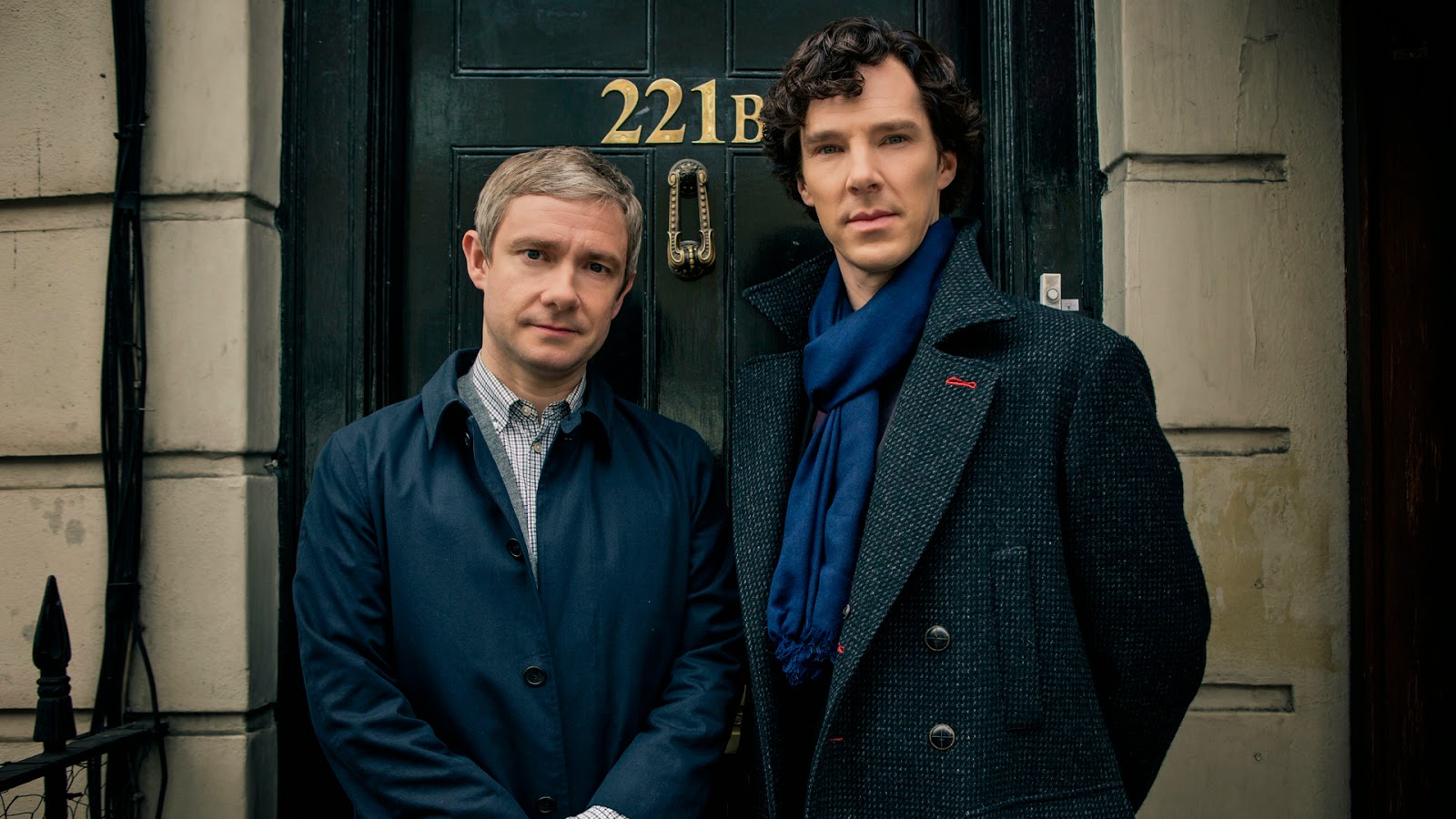
Last night, viewers in the US got to see what viewers in other parts of the world have already seen: the first episode of the third season of the phenomenally successful BBC show Sherlock . I've already seen it — twice, in fact — because I enjoyed previous seasons of the show enough to work around the BBC website's geographical limitations and watch the episode when it first aired, and then I saw it again at a local cinema's preview showing, where my friend Ann McClellan gave a presentation on Conan Doyle and Sherlock . I've also seen the other two episodes of the season, watching episode 2 twice and episode 3 once. Recently, I watched the 13-episode first season of NBC's Hannibal , based on Thomas Harris's Hannibal Lecter character, and I've been thinking about certain overlaps and significant contrasts between the two shows in their approach to their material. The comparison first occurred to me after I re-watched the first episode of Sherlock in...

Some Books

Image
My brain doesn't seem to want to participate in year-end roundups this year, as every time I try to think about what books or films or music or legumes I've encountered, I mostly go blank. I seem to have lost the capacity to link such experiences to the experience of time in annual chunks. I wouldn't in any case be able to write a "best of the year" post because I've spent a lot of this year catching up with stuff from other years (well, no old legumes -- that would be gross...). Probably still a hangover effect from my years as series editor for Best American Fantasy. However, some books, at least, do come to mind as things I haven't posted enough about here, and which I would like to recommend. So if you get some good giftcards or something during the holidays and feel impelled to buy something; or if you happen to want some stuff to look for in the library, here are a few titles (arranged alphabetically by author) I've thought rewarded the time...

Worlds Apart

Image
I was writing a comment in reply to Ray Davis on a previous post, and realized it might be better as a post than a comment. Here's Ray's original comment : Huh. The  "problem that had long puzzled"  Josipovici was precisely -- like  precisely , except for some name-swapping which sharpens the point, like Joyce for Mann and Beckett for Bernhard -- what led me to start looking into science fiction in 1976. (And eventually led me here, of course.) From what I've read of Josipovici, I suspect he arrived at different answers than myself. My feelings are similar, and are one of the reasons that though my particular pleasures are different from Josipovici's, I'm sympathetic to his argument. Those feelings are also a reason why I have a knee-jerk negative reaction to arguments that pose science fiction (broadly defined) as the opposite of Modernism .  (Different, sure.  Opposite, nope.)  That's an interpretation that doesn't work for me because it co...

Checking In

Egads, I knew October was going to be a slow month for blogging, but this is my first post since September 24... What have I been up to, you ask?  (Well, no you don't.  But I'm going to pretend you do.  Allow me a few of my delusions, please!  I gave up on world peace and my imaginary friends, so can't I at least have this?!?) What I've been up to is mostly just the ordinary stuff of life, which for me right now primarily means teaching at two different schools, one a university, the other a high school, in a schedule that's leading to a bit of brain discombobulation.  A lot of preparation for next term's classes, too, particularly the Gender & Science Fiction one at Plymouth State -- all the suggestions from folks were helpful, because even in the case of things I was already considering, it's helped me focus.  I still have a week till I have to turn in book orders, so I haven't settled on much yet, but I do know I'll be using The Left Hand ...