Posts

Showing posts with the label mysteries

Shetland: Attending to the Consequences of Violence
Image
From now on, whenever someone argues that their story or tv episode or movie or whatever absolutely couldn't possibly work without a graphic rape scene, I will think of  episode 5 of the third series of the BBC show Shetland . The episode includes the kidnapping and rape of a regular series character. But we don't even see the kidnapping, only the moments leading up to it and then other characters' growing concern over the disappearance. She reappears, walking barefoot to a Glasgow police station, and at first there is relief: She's safe and she doesn't seem harmed. And then she tells the series' main character, DI Perez, that evidence will need to be collected. The rest of the episode and much of the final episode pay careful attention to her and her colleagues' work to come to grips with the event. The drama plays out through dialogue and restrained, thoughtful acting. I tend to watch murder shows with dinner. I'm quite used to munching away amid...

False Detectives, True Discourses, and Excessive Exegeses

Image
I got caught up in the hype, got curious, and found a way to watch True Detective . It's my kind of thing: a dark crime story/police procedural/serial killer whatzit. Also, apparently the writer of the show, Nic Pizzolatto, is aware of some writers I like, and even one I know, Laird Barron . (Hi Laird! You rock!) What struck me right from the beginning was the marvelous music, selected and produced by the great T-Bone Burnett , and the cinematography by Adam Arkapaw , who shot one of my favorite movies of recent decades, Snowtown , and also the very good film Animal Kingdom and the marvelous Jane Campion TV show Top of the Lake . Something about Arkapaw's sensitivity to color, light, and framing is pure mainlined heroin to my aesthetic pleasure centers. If I found out he'd shot a Ron Howard movie, I'd even watch that. So many other people have discussed the show that there are now, I'm sure, nearly as many words written about it as there are words in Wikiped...

The Affect Effect: Notes on Sherlock and Hannibal

Image
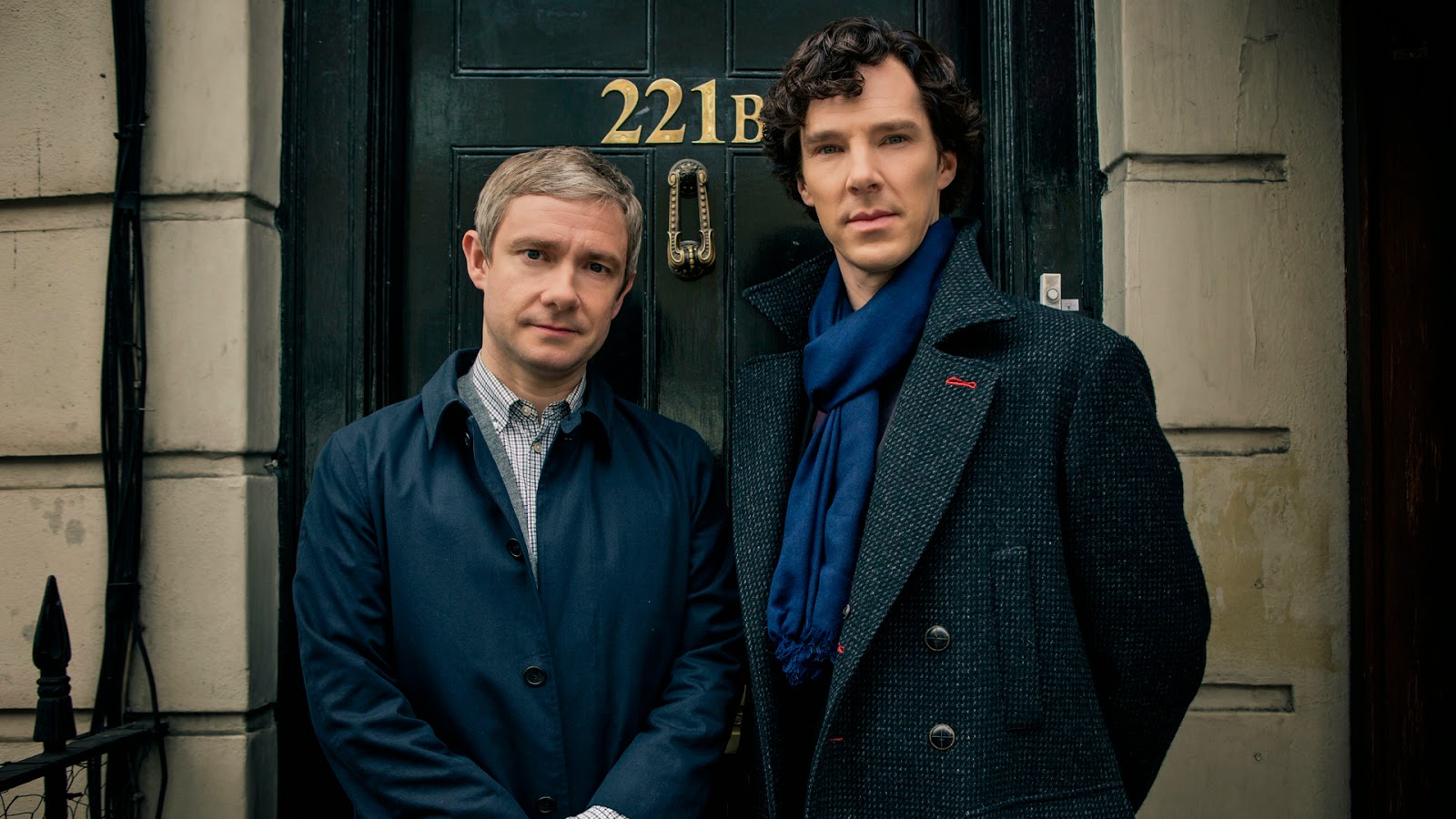
Last night, viewers in the US got to see what viewers in other parts of the world have already seen: the first episode of the third season of the phenomenally successful BBC show Sherlock . I've already seen it — twice, in fact — because I enjoyed previous seasons of the show enough to work around the BBC website's geographical limitations and watch the episode when it first aired, and then I saw it again at a local cinema's preview showing, where my friend Ann McClellan gave a presentation on Conan Doyle and Sherlock . I've also seen the other two episodes of the season, watching episode 2 twice and episode 3 once. Recently, I watched the 13-episode first season of NBC's Hannibal , based on Thomas Harris's Hannibal Lecter character, and I've been thinking about certain overlaps and significant contrasts between the two shows in their approach to their material. The comparison first occurred to me after I re-watched the first episode of Sherlock in...

A Few Words for Wallander

Image
Some time in the winter, I fired up the Netflix machine and watched the first few episodes of Wallander  with Kenneth Branagh . It was occasionally interesting, but I found Branagh's lugubrious, blubbery, hangdog acting insufferable. It's rare that I like Branagh in anything, so I decided to try out the other Wallander  that was available for streaming: the 2009/10 Swedish series starring Krister Henriksson . This week, I finally let myself watch the last two episodes available. I haven't loved a TV show this much in ages, and the final episode of series two is heartwrenching, though the last scenes are sweet and touching. I was moved halfway through the episode to send a frantic text to a friend (who, though she hasn't watched the show, has been amused by my growing obsession): "They killed Wallander's dog! The heartless Swedes!" I was, it turned out, jumping to conclusions and slandering an entire nation. But I have never been moved to send a text...

Black Star Nairobi by Mukoma wa Ngugi

Image
Last year, I wrote about Mukoma wa Ngugi's  Nairobi Heat , seeing it as an interesting, if flawed, first novel. Now Melville House has released Mukoma's second novel, a sequel to the first: Black Star Nairobi , a political thriller that begins as a detective story and ends up taking us from Kenya to Mexico to the U.S. and then back to Kenya at the time of the election crisis of 2007/08 . The writing in Black Star Nairobi  is more assured than in Nairobi Heat , and the plot and structure are more ambitious. The ambition is also the novel's curse, because the text is not up to the task of portraying and dramatizing the richness of its worlds and ideas — it's a book that needs to be twice its length or half its plot.

Nairobi Heat by Mukoma wa Ngugi

Image
I read Mukoma wa Ngugi's Nairobi Heat (part of Melville House's International Crime series) a few weeks ago, but haven't had the time to write much about it, so what I say here is likely to be more general than it would have been before. Though I think the novel has some significant flaws, those flaws are mitigated, for me at least, by a number of real strengths, and in the weeks since finishing it, moments from the novel have scratched through my thoughts and memory. For that reason, I think it's a book well worth reading. First, to get unpleasantness out of the way, here's what I see as the novel's flaws: Events often feel like they exist for the sake of the plot's convenience and not for any reason organic to the narrative; some moments that should evoke an emotional connection from readers are not set up in a dramatic way that would allow such emotion to come to the surface and are instead sped through (a particular fault in the romantic relation...

Borges y Boucher, Yo

Image
In my latest Sandman Meditations column, I tackled the prologue of Season of Mists , and ended up spending a lot of time talking about Jorge Luis Borges and his first appearance in English: "The Garden of Forking Paths"  in the August 1948 issue of Ellery Queen's Mystery Magazine : The EQMM “Garden of Forking Paths” appeared in a translation by Anthony Boucher, which means that Boucher was not only a well-respected writer of mysteries and science fiction, not only an important and influential reviewer of mystery fiction, not only the man whose name is honored by the annual World Mystery Convention (Bouchercon) and its awards (the Anthonies), not only the man who co-founded The Magazine of Fantasy and Science Fiction , not only an important mentor to many writers, including Philip K. Dick — he was also the man who first brought Borges’s work to the United States. Later translations would become the standard ones (as far as I know, Boucher’s has rarely been reprinted),...

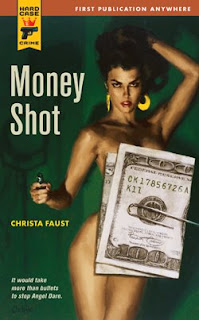
Money Shot by Christa Faust

Image
I confess: I like the idea of noir novels more than I tend to like noir novels themselves. ( Noir movies I often enjoy watching, but there are few I've found very memorable, for whatever reason.) In fact, I don't much like mystery novels of any sort, though I've read a lot of them in a desperate attempt to like them more. I've tried at least one novel by all the classic mystery writers I know of, and the only such writer I've managed to read more than one book by with any pleasure is Patricia Highsmith. I've tried contemporary mysteries by a bunch of different writers, but hardly any of them have remained in my memory. I don't know all the reasons for my inability to really embrace mystery and crime novels -- strange, I think, given my interest in the psychology and sociology of violence -- but I think most of it comes from my general indifference to plot. I like books that have some sort of narrative, certainly, but I don't generally care for bo...