Posts

Showing posts with the label sentences

John Keene's Sentences

Image
  This short essay about John Keene's story collection Counternarratives was first published at the Emerging Writers Network site in May 2017. That site seems a little buggy these days, so for the sake of archiving the essay, I am copying it here. Counternarratives remains for me the most impressive story collection by an American writer published in the 21st century.   KEENE SENTENCES   The stories of John Keene provide an aesthetic to push against the power of the cultural forces that venerate quick, easy thinking; forces that reduce knowledge to soundbites and hottakes and quick! mustread! breaking! stories, enforcing a compulsory presentism that is little more than mass amnesia — and self-aggrandizing mass amnesia at that. It’s a prose aesthetic to fight against any impulse insisting life here and life now is the most, the best, the worst, the only. His 2015 collection Counternarratives — easily one of the most invigorating English-language s...

The Mere Wife by Maria Dahvana Headley

Image
I keep recommending Maria Dahvana Headley's most recent novel, The Mere Wife , to people, and so it seems I should write a little something about it. (Had my summer and, especially, fall been less fraught, I would have written about The Mere Wife  some time ago, because it's a terrific novel and Maria and I have been friends for more than 20 years now, making me very much inclined to tell the world when I think she's done great work. But life intervened, as it does. Here I am, though: World! The Mere Wife  is great work!) The Mere Wife   slyly elides some of the differences between novels, epics, and narrative poems. Novels are omnivorous monsters that eat up every form and mode they encounter, and a writer who knows this — who, in fact, revels in it — is set to wrangle and wrestle the beast into a powerful shape. Since The Mere Wife  is inspired by/riffing on  Beowulf ,  a raid on the fortresses of other storytelling forms is especially ...

A Sparkling Sentence

Image
This year is Muriel Spark's centenary , and it's been fun to encounter the various tributes to her. I decided to reread The Prime of Miss Jean Brodie , her most famous book, because I haven't read it in twenty years or so, though much of it remains vivid in my memory. It was my first Spark, and while I think I appreciated the sharpness of her language at the time, I valued other things in the book. Rereading it now, it is her sentences that amaze me most, because I've learned over the years that one of the greatest pleasures in reading Spark is the pleasure of watching her make complex linguistic acts look easy. Here's an example that I stand in awe of, a single sentence that is a short story unto itself: Even stupid Mary Macgregor amazed herself by understanding Caesar’s Gallic Wars which as yet made no demands on her defective imagination and the words of which were easier to her than English to spell and pronounce, until suddenly one day it appeared...

Sentences Seeking, and Finding, Forms: On Some Passages in Barnaby Rudge

Image
William Gass died a few days ago, and, as I do when a writer I value dies, I returned to his work. I read around in In the Heart of the Heart of the Country , and then A Temple of Texts , where, in the essay "The Sentence Seeks Its Form", I read: Between Shakespeare and Joyce, there is no one but Dickens who has an equal command of the English language. This struck me because I hadn't ever particularly thought of Gass as a Dickens man. You won't find, for instance, a Dickens novel listed in the book's earlier essay on "Fifty Literary Pillars" , nor has Gass written at length about Dickens in the way he has so many other writers. (But still, many of us have writers we cherish, or at least admire, about whom we've written little or nothing.) I found, going back through his essays, that Gass has scattered brief insights about Dickens throughout; not only is there the wonderful discussion of David Copperfield , Mr. Micawber, and details in ...

Counternarratives by John Keene

Image
John Keene's Counternarratives  is one of the most impressive short story collections I've ever read from a living writer, and I was pleased to have the chance to write about it for my old blogosphere friend Dan Wickett, who does wonders celebrating short fiction via his Emerging Writers Network. Here's a taste: The stories of John Keene provide an aesthetic to push against the power of the cultural forces that venerate quick, easy thinking; forces that reduce knowledge to soundbites and hottakes and quick! mustread! breaking! stories, enforcing a compulsory presentism that is little more than mass amnesia — and self-aggrandizing mass amnesia at that. It’s a prose aesthetic to fight against any impulse insisting life here and life now is the most, the best, the worst, the only. His 2015 collection Counternarratives — easily one of the most invigorating English-language story collections of the last 25 years — offers us a powerful contemporary toolbox of approaches...

What Belongs to You by Garth Greenwell

Image
Garth Greenwell's debut novel What Belongs to You  is one of the most celebrated and successful gay novels of 2016. Its success seems to me both odd and gratifying. It is a book that garnered the attention of the literati, and not just the gay literati, though it certainly has that (Edmund White blessed it with a blurb). It received praiseful notice from nearly all the major literary institutions in the U.S. (and elsewhere). It is a remarkable novel, but were I a literary agent or publisher, much of what makes the novel remarkable would have caused me to assume it would not sell very well and would find, at best, a niche audience. (This is perhaps reason #28,302 that it's good I'm neither a publisher nor an agent!) I don't know the sales figures for What Belongs to You , but it hit the LA Times  bestseller list for a couple weeks, got tremendous review coverage, and often seemed to be among the books of the moment — I traveled a lot during 2016, and nearly everyw...

"Anti-Fragile" by Nick Mamatas

Image
As a little addendum to my post about the somewhat narrow aesthetics of Ben Marcus's New American Stories  anthology, let me point you to Nick Mamatas's "Anti-Fragile" , a story that does pretty much everything I was hoping to find somewhere in New American Stories  and didn't. On Twitter, I said: Had enough of shallow stories told in short sentences & bite-sized paragraphs? Feast on "Anti-Fragile" by @NMamatas http://t.co/R28zqR5l2f — Matthew Cheney (@melikhovo) July 27, 2015 And that about sums up my feelings. Well, also: I may be partial, as I am an avowed and longstanding lover of long sentences , and this story is a wonderfully skilled, thrillingly long sentence. It's well worth reading and thinking about.

Notes on the Aesthetics of New American Stories

Image
Ben Marcus's 2004 anthology The Anchor Book of New American Short Stories  is a wonderfully rich collection for a book of its type. I remember first reading it with all the excitement of discovery — even the stories I didn't like seemed somehow invigorating in the way they made me dislike them. I've used the book with a couple of classes I've taught, and I've recommended it to many people. I was overjoyed, then, when I heard that Marcus was doing a follow up, and I got it as soon as I could: New American Stories . I started reading immediately. Expectations can kill us. The primary emotion I felt while reading New American Stories  was disappointment. It's not that the stories are bad — they aren't — but that the book as a whole felt a bit narrow, a bit repetitive. I skipped around from story to story, dashing in search of surprise, but it was rare. I tried to isolate the source of my disappointment, of my lack of surprise: Was it the subject matter? ...

Notes on a Sentence from "The Death of the Moth"

Image
Forced by some reductive power to declare a single favorite essay, mine would be "The Death of the Moth" by Virginia Woolf . It is a marvel of concision, and yet it contains the universe. It is an essay both personal and cosmic, material and spiritual. Whenever I teach writing, I use "The Death of the Moth" as an example of the interplay of form and content. (While I have seldom met a pairing I didn't want to deconstruct, the form/content binary is one I continue to find useful. Yes, the separation is problematic — what, in language, is content without form or form without content? — but I also find it a valuable way to talk about concepts that are otherwise invisible or easily muddled.) Usually, I take one sentence, scrawl it out on the board, and pick it apart. It's not always the same sentence, but recently I've been using this one: Yet, because he was so small, and so simple a form of the energy that was rolling in at the open window and drivi...

Happy Birthday to Virginia Woolf

Image
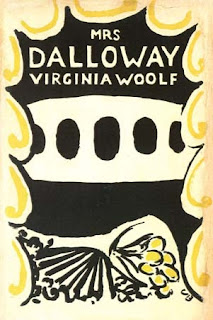
When one was young, said Peter, one was too much excited to know people. Now that one was old, fifty-two to be precise (Sally was fifty-five, in body, she said, but her heart was like a girl’s of twenty); now that one was mature then, said Peter, one could watch, one could understand, and one did not lose the power of feeling, he said. No, that is true, said Sally. She felt more deeply, more passionately, every year. It increased, he said, alas, perhaps, but one should be glad of it — it went on increasing in his experience. -- Virginia Woolf , Mrs. Dalloway Today is Virginia Woolf's 129th birthday. Woolf is one of my touchstone writers, a writer I've been reading for the majority of my life (really, I first tried to read Mrs. Dalloway in middle school -- I didn't get too far, but I found the first pages of the book utterly entrancing, and by the time I read it fully for the first time eight or nine years later, I had those pages nearly memorized). I've read all...

The Length of the Gimmick

J. Robert Lennon points to an essay by Ed Park in the NY Times from a couple days ago, "One Sentence Says It All" , which I missed until now, but which obviously appealed to me, an avowed lover of long sentences , because it concerns books that are written as a single sentence. Park's focus is primarily on what "really" makes something a one-sentence novel, a kind of purity test, while Lennon mostly just seems grumpy, declaring the whole idea to be "the kind of fake formal experimentation that a writer is more likely to use as cover for his incompetence than for any kind of genuine insight into character, situation, or language". I think Lennon's opinion is noxious, and I'm skeptical of any use of the word "gimmick" for a writing technique, because it seems to me a particularly prejudicial and generally inaccurate term -- in a broad sense, any literary (as opposed to purely pragmatic) way of writing is gimmicky, because any writ...

John Leonard (1939-2008)

Image
What I look for and care about in these various bunkers is the slice of the strange, the surprise of the Other, the witness not yet heard from, the archaeologies forgotten or ignored or despised. What I think about almost anything, from Henry Kissinger to Deng Xiaoping, from the doctrine of transubstantiation to the theory of surplus value to a tax on capital gains, from Murphy Brown to Thelma and Louise to Jelly's Last Jam , is a mess of juxtapositions, miscegenations, transplants and hybrids, atavisms and avatars, landlords and tenants, ghosts and gods; grace-notes and cognitive dissonance -- Chaos Theory, with lots of fractals. --introduction to The Last Innocent White Man in America Isn't it kind of stuck-up, wanting to live forever? --"Tropic of Cancer" All through my teen years, if I happened to sleep past 9 am, one of my parents would yell, "John Leonard's on!" and I would be awake and rushing downstairs to see the brief segment of ...

In Praise of Long Sentences

I've just begun reading Lucius Shepard's short novel Viator , and even though I'm only 35 pages in, it has already worked its way close to my heart by being constructed primarily (so far) of long, luxurious sentences, sentences that bloom with modifiers and clauses and details, sentences that are seldom awkward, because even though Shepard's prose has often been impressive since he first came to prominence in the early 1980s, his skill with language is now so polished and apparently effortless that sentences that feel remarkable on a first reading become even more astonishing when experienced a second or third time, and the cumulative effect of such stylistic high-wire acts being repeated page after page is to create a richness and density that many stories don't have at twice (or more) the length. Of course you'd like an example. Here, then, is the first paragraph of the book: Wilander had grown accustomed to his cabin aboard Viator . Small and unadorned...