Posts

Showing posts with the label grammar

Whose Word Crimes?

Image
Yesterday, "Weird Al" Yankovic released a video for his song "Word Crimes" , a parody of Robin Thicke's "Blurred Lines" . Since a lot of people I know are language folks of one sort or another, I saw it flow and re-flow through various streams of social media. But I had qualms. I love Weird Al, and he's been a formative influence on my life, since I started listening to him when I was a kid. (My entire sense of humor could be described by three childhood influences: Weird Al, the Marx Brothers, and Monty Python.) I also think the detestable "Blurred Lines" is ripe for ridicule and attack. And I like words. But how are we to understand the speaker in "Word Crimes"? Most people I saw who shared the video seemed to identify with the speaker. This is not as disturbing as people identifying with the rapey speaker of "Blurred Lines", but it reveals a certain cruelty in the feelings of people who want to be identifie...

Writing Tools

Image
photo by Eric Schaller I'm teaching a course called "Writing and the Creative Process" right now, and one of the things I would like to offer the students is a list of tools I've found actually helpful when writing -- computer programs and reference books, mostly. I thought it might be fun to open up the conversation and get some recommendations from people other than me, since my own practice is peculiar to, well, me. So, a question for you, O Denizens of the Internets: What have been the most helpful tools for you when writing? (And "writing" doesn't just mean you're a professional novelist whose last few books were sold to Hollywood. We all write things in our lives, whether business letters or shopping lists of secret poems we never show anybody. Everybody is qualified to answer this question who wants to!) I'll put my own essential items below the fold...

The Length of the Gimmick

J. Robert Lennon points to an essay by Ed Park in the NY Times from a couple days ago, "One Sentence Says It All" , which I missed until now, but which obviously appealed to me, an avowed lover of long sentences , because it concerns books that are written as a single sentence. Park's focus is primarily on what "really" makes something a one-sentence novel, a kind of purity test, while Lennon mostly just seems grumpy, declaring the whole idea to be "the kind of fake formal experimentation that a writer is more likely to use as cover for his incompetence than for any kind of genuine insight into character, situation, or language". I think Lennon's opinion is noxious, and I'm skeptical of any use of the word "gimmick" for a writing technique, because it seems to me a particularly prejudicial and generally inaccurate term -- in a broad sense, any literary (as opposed to purely pragmatic) way of writing is gimmicky, because any writ...

Readercon Reflections

Readercon 21 was, for me, exciting and stimulating, though this year in particular it felt like I only had a few minutes to talk with everybody I wanted to talk with.  I think part of this is a result of my now living in New Hampshire rather than New Jersey, so I just don't see a lot of folks from the writing, publishing, and reading worlds much anymore. Before I get into some thoughts on some panels and discussions, some pictures: Ellen Datlow's and Tempest Bradford's .  Tempest asked everybody to make a sad face for her, not because Readercon was a sad con (just the opposite!), but because it's fun to have people make sad faces.  The iconic picture from the weekend for me, though, is Ellen's photo of Liz Hand's back .  I covet Liz's shirt. And now for some only vaguely coherent thoughts on some of the panels...

Hopefully...

Image
I woke up this morning and thought, "I really need good ammunition against people who say that 'hopefully' can't be used to mean 'I hope'," because that's the sort of thing I tend to wake up thinking (yes, my paranoias are often about being mugged by style goons). I fired up my ol' computer machine and plugged into the intertubes and went immediately to Language Log , where I got a concise explanation of what I needed : Speaker-oriented (or "stance") adverbial hopefully has been taking abuse pretty steadily for 30 or more years (see MWDEU ). Linguists are mostly just baffled by this disparagement; see the discussion in the American Heritage Book of English Usage , where it's noted that " hopefully seems to have taken on a life of its own as a shibboleth." But the word fits right into long-standing patterns of the language -- cf. frankly in "Frankly, this soup stinks" and surprisingly in "Surprisingly,...

Omit Needless Advice

Geoffrey Pullum , co-author of The Cambridge Grammar of the English Language , is not celebrating the fiftieth anniversary of Strunk & White -- in an essay at The Chronicle Review , he writes: The book's toxic mix of purism, atavism, and personal eccentricity is not underpinned by a proper grounding in English grammar. It is often so misguided that the authors appear not to notice their own egregious flouting of its own rules. They can't help it, because they don't know how to identify what they condemn. It's a wonderful take-down, the best I've encountered since Louis Menand's examination of Eats, Shoots, and Leaves ("Why would a person who is not just vague about the rules but disinclined to follow them bother to produce a guide to punctuation?"). The power and popularity of such books is astounding. Both books were quite popular in the high school English departments I worked at, and Strunk & White was often assigned to students. I'm...

"My Dear Emily" by Joanna Russ

Image
I haven't even updated my course blog this term, so I feel a bit guilty writing here about a story I recently taught, but this story has dug its way into my head and I need to write down some ideas before I start babbling in Babylonian or something... As I've previously mentioned , I am using David Hartwell's The Dark Descent in my "Murder, Madness, Mayhem" class. It's one of my all-time favorite anthologies -- beautifully organized, with a selection of stories from various genres and eras, many of the stories allowing all sorts of discussion-fueling comparison, making it not just a great read, but a particularly valuable teaching tool.* I had the students read "My Dear Emily" on the same day they were to read J. Sheridan Le Fanu's "Schalken the Painter" and Charlotte Perkins Gilman's "The Yellow Wallpaper" . The idea was to talk about gender roles in the stories, since we've been talking about how writers use v...

One Story: Respect for Tradition

Image
One Story is a marvelous magazine (and not just because they published me -- that should, perhaps, be held against them...) and I can testify that it makes a great gift for people who like to read but generally feel too busy to do so, because receiving a nicely-produced story every three weeks or so in the mail is great fun. One Story now and then asks for donations, because the magazine is a non-profit and doesn't run ads. Clifford Garstang pointed out that a recent solicitation included this description of the "Editor" donation level: Editor: $100 – I’ll pay one author for their story Mr. Garstang notes that there is, according to certain interpretations of English usage, a problem with agreement between the one author and the plural pronoun their . What he doesn't say, though, is that One Story is simply showing their respect for the history of English literature and the language itself. According to the indispensible Merriam-Webster Dictionary of English U...

Even the Old Ones Say "Alright!"

Image
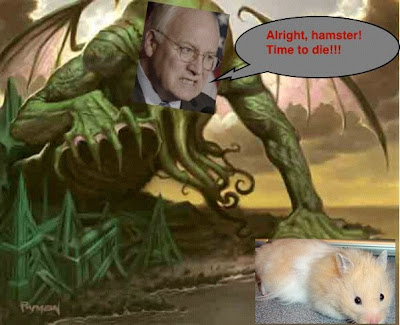
I kill hamsters!* I want to see them die!!! I'm even bringing my (extended) family into this! Say it one more time: ALRIGHT!!! *Yes, John says God only pokes hamsters in the rear end when we use "alright", but here he is not being entirely forthright with us. "A poke from God" is a well-known phrase used by certain secret societies and cabals to indicate a particularly painful form of torture that leads to death. Just ask somebody at the Creation Museum . They know about pokes from God.

Alright Already!

Image
Loath as I am to disagree with John Scalzi, I must note a difference of opinion with regard to the word "alright", which John proclaims is not even a word. And he thinks it's ugly. Whether it is ugly is a matter of taste, and I shan't argue that. Whether it is a word , though ... well, it's definitely a word, since it has boundaries and is used to convey meaning, though I will grant that most American dictionaries of English do not accept it as part of formal, standard English yet. I will also say here that I use the word "alright" much more often than I use the words "all right", and when an occasional copyeditor changes my alrights to all rights , I change 'em right back whenever possible. (Usually my sometimes-British/ sometimes-American punctuation distracts copyeditors from my other idiosyncracies, but not always.) In terms of grammar, usage, style, orthography, etc., I am a radical liberal. I teach my students standard English, ...