Posts

Showing posts with the label realism

45 Years

Image
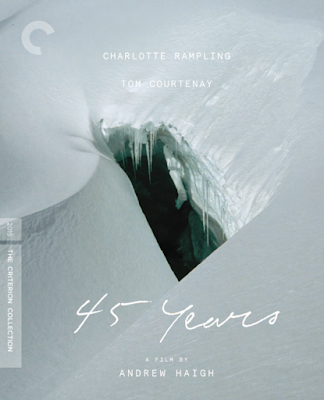
Andrew Haigh wrote and directed one of my favorite films of the century so far, Weekend , and his 2015 movie 45 Years  is based on David Constantine's breathtaking short story  "In Another Country"  — as rich and perfect a story as you're ever likely to read. For these reasons, I put off seeing the movie for a long time, because I feared it could not live up to my hopes and expectations for it. And no, it couldn't live up to my hopes and expectations, and my hopes and expectations did, indeed, get in the way — but it's still an impressive film. In particular, the performances and the cinematography are magnificent. The plot of 45 Years  is simple, and starts right from the second scene: An older couple, Kate and Geoff, are getting ready to celebrate their 45th wedding anniversary, having not been able to celebrate their 40th because of Geoff's heart bypass surgery. That week, Geoff receives an official letter letting him know that a body has been ...
Storytellers: Escaping the Nightmare of Myth in Chaudhuri and Rushdie

Image
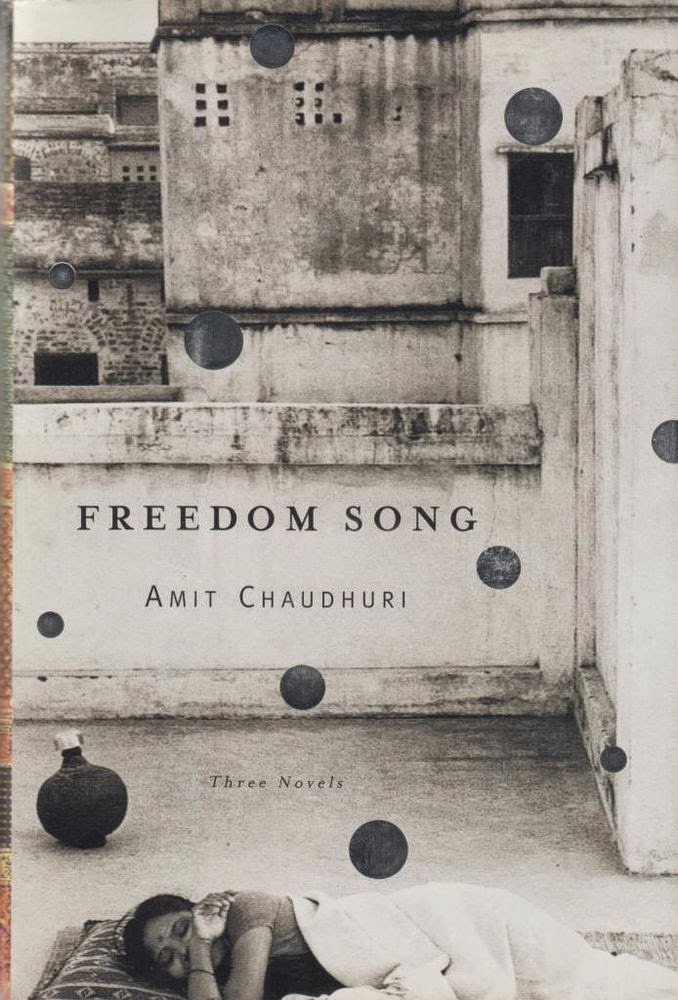
Continuing on from yesterday's post about Amit Chaudhuri's A Strange and Sublime Address (a novella included in the collection Freedom Song ), here's a bit more academic writing about the book. This time, my goal is to undermine, or at least question, the common opposition of Chaudhuri's "realism" to Salman Rushdie's "magical realism". The two writers have frequently been set against each other as polar opposites, but my argument here is that they have far more in common than might be obvious at first. .. In his 2009 essay “Cosmopolitanism’s Alien Face”, Amit Chaudhuri tells of a conversation he had with the Bengali poet Utpal Kumar Basu: We were discussing, in passing, the nature of the achievement of Subimal Misra, one of the short-story writing avant-garde in 1960s Bengal. ‘He set aside the conventional Western short story with its idea of time; he was more true to our Indian sensibilities; he set aside narrative’, said Basu. ‘That’s...

Reading In the Heart of the Country

Image
I create myself in the words that create me. — In the Heart of the Country I've recently completed a draft of a paper on J.M. Coetzee's second novel, In the Heart of the Country , writing about the book and its contexts (with regard to trauma theory and Afrikaner Nationalism), but as I read various scholarly analyses of it, as well as reviews of the novel when it was first published, what struck me was the book's relative neglect compared to Coetzee's other novels, and the general lack of enthusiasm for it. When I first read it some years ago, I found it befuddling and often tedious. But it stuck with me, even haunted me, and that's why I decided to take some time digging into it. Older now, more experienced in reading Coetzee, I found it immensely rich and a powerful reading experience. Though I've spent a few months reading and re-reading it closely, I still feel like I'm only beginning to get a grasp of all it's up to. It is impossible to s...

First Thoughts on The Childhood of Jesus by J.M. Coetzee

Image
Some preliminary, inadequate notes on J.M. Coetzee's new novel, The Childhood of Jesus , after a first reading: Kafka and Cervantes haunt this novel, as they haunt so much of Coetzee's work. Cervantes is there on the pages — the boy David carries around a children's copy of Don Quixote  and learns to read from it. Kafka is more of a ghost in the book, a presence haunting its words.  The Childhood of Jesus  tempts us toward reading it as allegory, a tendency common to Kafka's work, and Coetzee has written insightfully about Kafka many times, including a valuable essay on "Translating Kafka" in Stranger Shores  that criticizes Edwin and Willa Muir's allegorical and religious reading of Kafka and the effect it had on their translations. Reading Coetzee allegorically is always a false path and yet one he seems to enjoy tempting readers toward. This time, the temptation is even in the title. The title is mischievous, because there is no character named...

False Teeth and the Foreign Office

Terry Eagleton, from a review of the 50th anniversary edition of Erich Auerbach's Mimesis: To describe something as realist is to acknowledge that it is not the real thing. We call false teeth realistic, but not the Foreign Office. If a representation were to be wholly at one with what it depicts, it would cease to be a representation. A poet who managed to make his or her words ‘become’ the fruit they describe would be a greengrocer. No representation, one might say, without separation. Words are certainly as real as pineapples, but this is precisely the reason they cannot be pineapples. The most they can do is create what Henry James called the ‘air of reality’ of pineapples. In this sense, all realist art is a kind of con trick – a fact that is most obvious when the artist includes details that are redundant to the narrative (the precise tint and curve of a moustache, let us say) simply to signal: ‘This is realism.’ In such art, no waistcoat is colourless, no way ...

Worldbuilding

Image
From three of the most interesting things I've read recently and, thus, started thinking about together... M. John Harrison: A world can be built in a sentence, but epic fantasy doesn’t want that. At the same time, it isn’t really baggy or capacious, like Pynchon or Gunter Grass. It has no V . It has no Dog Years . It has no David Foster Wallace. It isn’t a generous genre. The same few stolen cultures & bits of history, the same few biomes, the same few ideas about things. It’s a big bag but there isn’t much in it. With deftness, economy of line, good design, compression & use of modern materials, you could ram it full of stuff. You could really build a world. But for all the talk, that’s not what that kind of fantasy wants. It wants to get away from a world. This one. Ian Sales on Leviathan Wakes  by James S.A. Corey: There are some 150 million people living in the Asteroid Belt. The greatest concentration is six million in the tunnels inside the dwarf planet ...

Report Realism

At Gukira, Keguro has posted some provocative thoughts on "report realism" in Kenyan fiction : Over the past 15 years and more specifically the past ten years or so, Kenyan writing has been shaped by NGO demands: the “report” has become the dominant aesthetic foundation. Whether personal and confessional or empirical and factual or creative and imaginative, report-based writing privileges donors’ desires: to help, but not too much; to save, but not too fast; to uplift, but never to foster equality. One can imagine how these aims meld with traditional modes of realism and naturalism and also speak to modernist truncations and postmodern undecidability. However, report realism names a more historically accurate way to name a genre indebted (very literally) to NGOS in Kenya. The report aesthetic goes beyond citing NGO facts and figures. It is concerned, above all, with a search for truth and accuracy and is threatened by imaginative labor. I cannot comment on the specific a...

"Peter Torrelli, Falling Apart" by Rebecca Makkai

I've been reading through this year's Best American Short Stories , edited by Geraldine Brooks, little by little, almost randomly, not quickly, and mostly as a reward to myself when I get other work done. I got it as an ebook, because that's a nicely convenient way to read it. What ultimately attracted me to it was that this year's table of contents is more interesting to me than any in the last few years. (Finally, a BASS  that isn't a Best American Rich White People !) My favorite story so far is Rebecca Makkai's "Peter Torrelli, Falling Apart", originally published in Tin House . For me this story alone is easily worth what I paid for the book.

Oneiric Realism

Image
From a recently-unearthed interview with Pier Paolo Pasolini , conducted three days before he was murdered: Have you bid farewell to the realism of your first features for good? I don't agree with this. After 15 years in Italy, they finally showed Accattone on TV. We realized it is not a realist film at all. It's a dream, it's an oneiric movie. Didn't they consider it a realistic film in Italy? Yes, but it was a misunderstanding. When I made it, I knew I was doing a very lyrical film, not oneiric as it now seems, but deeply lyrical. I used that soundtrack and shot it in a certain way for a reason. Then what happened was that the realistic world I drew inspiration from for Accattone disappeared; it is no longer there, so the film is a dream of that world. Mamma Roma is realist… Mamma Roma is more realistic than Accattone , maybe. I should watch it again. It is less accomplished, less beautiful and that's because it is less dream-like.

Short Cuts

For a long time, one of Robert Altman's best movies, Short Cuts , seemed to have been lost in the valley between Altman's big popular successes, The Player and Gosford Park -- good films both, particularly the latter, but Short Cuts is one of the greatest achievements in American film. Finally, The Criterion Collection has brought Short Cuts to DVD, and it gives us a chance to look again at a movie that does exactly what an adaptation of literature from one medium to another should do: create something original and profound. Short Cuts is based on a handful of stories and one poem by Raymond Carver . Carver's widow, Tess Gallagher, supported Robert Altman's idea of melding the original material, moving characters around, relocating the stories from their various settings to Los Angeles, and letting them all happen concurrently over the course of a few days. Altman collaborated on the script with Frank Barhydt, and together they not only cut up the stories, b...