Posts

Showing posts with the label science fiction

Conquest by Nina Allan

Image
I happened to read a brief review of Nina Allan's new novel Conquest by Ian Mond, wherein he calls it "a story about alternative truth, misinformation and art" that "features essays on the work of Shane Carruth and Hans Werner Henze, a 1958 science fiction novella that proves central to Frank’s ideology, and an obsession with J.S. Bach" — and I immediately ordered it from Blackwell's , where it was available for a good price and free shipping to the US. (It seems only to be available in the UK edition so far.) You had me at conspiracy theories and Bach. What Conquest turns out to be is one of the most quietly devilish explorations of narrative uncertainty that I know, a book where the hermeneutical fireworks burst at such distance that it takes a while for the soundwaves to thunder toward us after the sky has blown up. It is quite an easy book to read, rarely feeling dense or leaden even when discussing obscure material, yet it enacts some of the insights...
On Moderan by David R. Bunch

Image
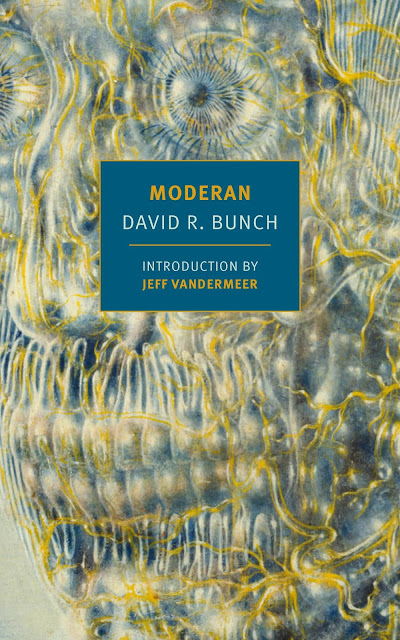
For The Millions , I wrote about David R. Bunch's extraordinary Moderan , recently republished by NYRB Classics for the first time in about 50 years and with material that's never before appeared in book form. Here's a taste: Moderan collects dozens of brief stories set in a future world apparently destroyed by nuclear bombs, a world where the landscape has been entirely paved over with plastic and the surviving humans have transformed themselves into cyborgs, their bodies mostly replaced with metal, leaving only a few flesh-strips as evidence of their old form. The men with the most metal become warriors whose identity is merged with the Stronghold that houses them, and the pleasure and glory of Moderan is the warring of its Strongholds. (Most of the stories in Moderan focus on Stronghold 10, the best at warring.)  The new-metal men hunker down in their Strongholds and wage war against each other. War is the most exciting thing in everyone’s lives, the way to...

Gardner Dozois (1947-2018)

Image
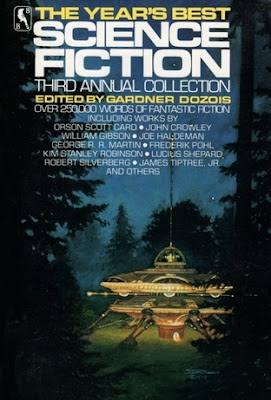
The first rejection letter I ever got was from Gardner Dozois . I was in 6th grade and had just learned about submitting stories to magazines; I had also just started reading my mother's boss's copies of Isaac Asimov's Science Fiction Magazine , which Dozois had recently become editor of. I don't remember anything about the story I submitted, but I'm sure it was awful. I don't think I expected it to be accepted, because what I most remember is how excited I was to get a letter from the editor. My parents were kind and didn't tell me it was a form letter, nor that the signature was printed onto it, not written by the editor himself. I brought it to school to show my teacher. She, too, very kindly did not tell me that thousands of people likely got just this same letter. (After a few more submissions, I figured it out.) Dozois also edited what may be the single most important anthology in my life: The Year's Best Science Fiction, Third Annual Collecti...

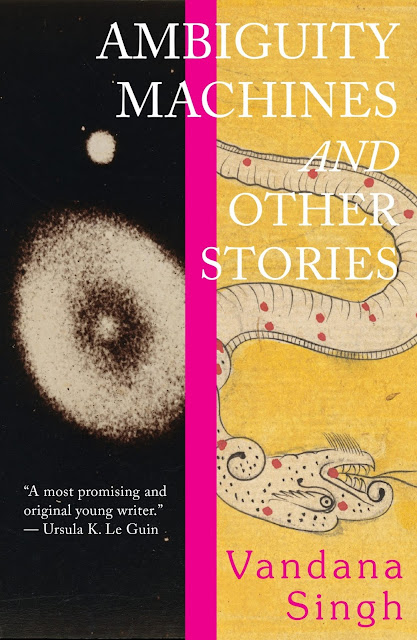
Ambiguity Machines and Other Stories by Vanana Singh

Image
For the Los Angeles Review of Books , I wrote about one of my favorite recent collections of short stories, Vandana Singh's Ambiguity Machines , published by the great Small Beer Press : There is a stately elegance to all the stories collected in Ambiguity Machines and Other Stories , Singh’s second collection after The Woman Who Thought She Was a Planet and Other Stories . Both books are rich with models of what science fiction can achieve as well as models of the short story as a form. Even when she is writing about far-future, faster-than-light-traveling aliens, Singh never resorts to the clichĂ©s familiar from space opera unless to undo them, never forces fast pacing with staccato sentences and short paragraphs, never plays gotcha! with the reader. Singh is a scientist — a professor of physics — and all of her stories show a scientist’s determination to develop ideas carefully and responsibly.  Yet Singh is also an artist, a writer who evokes sensual wonders in musical pr...

Ursula Le Guin: In Your Dreams, In Your Ideas...

Image
1. I am writing this on Virginia Woolf's 136th birthday. Ursula K. Le Guin , who died a few days ago, was a lifelong reader of Woolf's work, and the trace of Woolf's writing and thinking can be found not only throughout Le Guin's essays, but also in her fiction, different as it is in style and substance from Woolf's own. Le Guin not only read the famous novels, but she also cherished some of the works that get less notice these days, including Three Guineas , a fierce critique of patriarchy and militarism, the Woolf book that I think most deserves a revival in our cruel, murderous era. It's likely that I started reading Woolf because of Le Guin. I was probably 12 or 13 years old, I had heard that Le Guin was among the greatest of science fiction writers, so I sought out her work, and the library had some anthologies with her short stories in them ( The Hugo Winners  volumes, Again, Dangerous Visions , etc.) as well as her essay collection  The Language o...

The Return of David R. Bunch

Image
In the earliest days of this blog, I declared David R. Bunch to be "unjustly neglected". This was true back then, but not nearly as true as it is today, when all his books are out of print and usually sell for high prices on the secondary market (if you can find them). After I wrote that post in 2004, Jeff VanderMeer and I started talking about ways to get Bunch back into print. I sought out every stray Bunch story I could find. I tracked down the rightsholder. I typed up a section of Bunch's novel-in-linked-stories  Moderan  before tendonitis forced me to stop typing much of anything for a few months, and made the thought of returning to typing up Moderan  painful. Various obstacles presented themselves. (I started a master's degree. I became series editor for the  Best American Fantasy  anthologies. I moved to New Jersey. My father died . I moved back to New Hampshire. Etc.) In amidst it all, I couldn't follow up on the idea of reprinting Bunch, thou...

Nonfiction for Fiction Writers

Image
I'm just back from Readercon 27, the annual convention that I've been to more than any other, and for which (a while back) I served on the program committee for a few years. At this point, Readercon feels like a family reunion for me, and it's a delight. Here, I simply want to riff on ideas from one of the panels I participated in. Friday, I was on my first panel of the convention, "Nonfiction for Fiction Writers", with Jonathan Crowe, Keffy Kehrli, Tom Purdom, Rick Wilber. It was good fun. I'd taken lots of notes beforehand, because I wasn't really sure what direction the panel would go in and I wanted to be prepared and to not forget any particular favorites. Ultimately, and expectedly, I only got to mention a few of the items I was prepared to talk about. However, since I still have my notes, I can expand on it all here...

Aurora by Kim Stanley Robinson

Image
To make Kim Stanley Robinson's Aurora make sense, I had to imagine a metafictional frame for it. The novel tells the story of a generation starship sent in the year 2545 from the Solar System to Tau Ceti. It begins toward the end of the journey, as the ship approaches its destination and eventually sends a landing party to a planet they name Aurora. The narrator, we quickly learn, is the ship's artificial intelligence system, which for various reasons is learning to tell stories, a process that, among other things, helps it sort through and make sense of details. This conceit furthers Robinson's interest in exposition, an interest apparent at least since the Mars trilogy and explicit in 2312 . As a writer, he seems most at home narrating scientific processes and describing the features of landscapes, which does not always lead to the most dynamic prose or storytelling, and he seems to have realized this and adjusted to make his writerly strengths into, if not his bo...

The Cambridge Companion to American Science Fiction: Why American? Who American? What American?

Image
Cambridge University Press recently released The Cambridge Companion to American Science Fiction edited by Eric Carl Link and Gerry Canavan, a sequel, of sorts, to 2003's The Cambridge Companion to Science Fiction edited by Edward James and Farah Mendlesohn. I bought the James and Mendlesohn volume at the first science fiction convention I ever attended, the Worldcon in Boston in 2004, and I think it's an admirable volume that mostly does its best to try for the impossible, which is to present a coherent overview of the history and scholarship of science fiction as a genre-thing (mostly in the Anglo-American mode). I have mixed feelings about the Cambridge Companion to... series, because the volumes often feel like grab-bags and pushmi-pullyus , a bit too specific for people looking for an introduction to the scholarship on a topic, a bit too general for people with knowledge of a topic. They often contain a few excellent individual chapters amidst many chapters that fe...

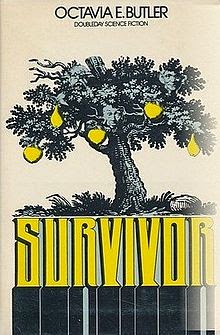
Notes on Octavia Butler's Survivor

Image
After reading Gerry Canavan's essay on two newly published short stories by Octavia Butler , one of which is a prequel to her 1978 novel Survivor , I decided it was time for me to read Survivor , since though I'd read most of Butler's books, and repeatedly assigned a couple of them in classes, I'd never gotten around to this one. The problem, however, is that Survivor is a book Butler disavowed and, once she had the ability, she prohibited it from being reprinted. Used copies tend to sell for at least $65 (although one just sold on E-Bay for $15. Alas, I discovered it only after the sale!). However, I figured I might be able to get a copy through interlibrary loan, and that's how I discovered my university library had a copy. (You can also find a bootleg PDF online if you search for it. But I didn't tell you that.) I went to the library fully expecting that the book did not exist — that it had disappeared off the shelf without anyone noticing, or that f...

The Church of Science Fiction

Image
Back in January, having imbibed too many book reviews and flame wars, I spouted on Twitter : "Most critical writing could be summed up as, 'My god is an awesome god! Your god sucks.'" That especially seems to be the case with so much writing about science fiction, which is less rigorously analytical than it is theological. Let's look at two examples. Adam Roberts's new Guardian essay on science fiction and politics reminded me of a provocative essay in the current issue of Science Fiction Studies , "Fascism and Science Fiction" (JSTOR) by Aaron Santesso. Here, I'm not going to wrestle with their arguments so much as speculate (perhaps irresponsibly, erroneously, ridiculously) on what itch such arguments scratch, because though I am skeptical of the overall thrust of both pieces, I don't find either to be especially bothersome. As I read each, I realized that I didn't understand the desires and assumptions that motivat...

The American Shore by Samuel R. Delany from Wesleyan University Press

Image
Now available for pre-order. Here's the Wesleyan University Press page for it. Here's an excerpt from the introduction, should your appetite need whetting: It may, on a quick glance, appear to be a book about a short story. On further examination, it may appear to be a book about how science fiction works, or a contribution to the literary and cultural theory of its day. It is those things, but not only those things. Like so much of Delany’s writing, its strategies and concerns nudge our view wider. Much as the best science fiction’s trivalent discourse easily lures us into considering the meaning produced by the intersections of world and text, and thus provides a powerful space for reflection on both, so Delany’s dive over and between the lines of “Angouleme” stands as a model for and instigator of various levels of thought about all the signs and languages that produce and obscure our lives. No great text ever ends if there are still readers to read it and re-read it,...

Samuel R. Delany: Another Roundtable

Image
Recently, Locus published an online discussion of the work of Samuel R. Delany with a bunch of different writers and critics, primarily aimed at discussing Delany’s status as the newly-crowned Grand Master of the Science Fiction Writers of America . Plenty of interesting things are said there, and the participants include a number of people I’m very fond of (both as writers and people), but the particular focus ended up, I thought, creating a certain narrowness to the discussion, especially regarding the post- Dhalgren works, and I thought it might be nice to gather a different group of people together to discuss Delany … differently. So here we are. I put out the call to a wide variety of folks, and this is the group that responded. We used a Google Doc , and the discussion grew rhizomatically more than linearly, so you'll see that we sometimes refer to things said later in the roundtable. (This makes for a richer discussion, I think, but it may be a little jarring ...

Jerry Garcia Reads...

Image
A friend sent me the above photo this morning. "You probably know more about Sci Fi and Fantasy publications than anyone I know," he wrote, "so can you possibly identify the book that Jerry Garcia is reading in the attached photo. It would mean a lot to thousands of Deadheads." I like a challenge. The picture is of such low resolution I almost couldn't make out anything helpful about the book, but I was determined. The title seemed long and the more I stared at it, the more it looked like some sort of anthology title ... The Best something? ... maybe a best of the year collection? ... no, best of fantasy and science -- The Best from Fantasy and Science Fiction , I bet. I've got a few copies of that longrunning series of stories from the venerable magazine , but all mine are old hardcovers picked up at library sales. I'm not sure I've ever even seen one of the paperbacks, or knew that there were  paperbacks of the series. But God invented ISFDB ...

Extra Star Drives for Empty Space

Image
As I mentioned when it was published, my review of M. John Harrison's Empty Space  for Strange Horizons was a more polished version of a rather ragged, untamed essay. For the terminally curious, here are the parts that I cut. Most of the cuts were done for reasons of focus; a few I made simply because the sense of the sentences seemed, on reflection, too hermetic (or just wrong). To indicate context and provide some form, I've included connecting material at the beginning and end.

Empty Space by M. John Harrison

Image
My review of M. John Harrison's extraordinary novel Empty Space  has been posted at Strange Horizons . My original version of this review was a long, crazy, rambling essay. Editor Abigail Nussbaum did heroic work helping me cut it down into something for a general audience. I like both versions — this one is much more a review, the longer version is ... brain spewings. Abigail kindly suggested that I post the cut pieces here on the blog, and I will do that later this week. I think the Strange Horizons  version is perfectly good for 90+% of readers, but a few folks might enjoy seeing what zany lands this great book, and its predecessors, sent me to. Update:   And here are the deleted passages .

Locus 20th & 21st Centuries Poll

Locus  this month has been conducting a poll to find out the "best" science fiction and fantasy novels and short fiction of the 20th and 21st centuries. Though I first suggested on Twitter that I would be filling it all in with Raymond Carver stories, I gave in today at the last minute and instead filled in the poll with some choices other than Carver stories (though I was tempted to put "Why Don't You Dance?" on there, since it has a certain fantasy feel to it, at least to me). I'll post my choices after the jump here.

The Man Who Had No Idea: Getting Into SF

I saw an article at World Literature Today 's website called "Fun with Your New Head: Getting into SF" , and thought, "Hey, this'll be great — they probably have a good list of science fiction from around the world and resources for people to find out more about world SF. I love it when that happens!" Sadly, no. Writer Michael A. Morrison instead says reading William Gibson's first two novels is hard, so here are a bunch of critical studies of SF that you should read. This is perverse. And it is not helpful. Do not listen to this article, or at least any of it before the final paragraph where The Wesleyan Anthology of Science Fiction is mentioned. That's a perfectly good introduction , though weak on work from the last 10 years. What a failure for a magazine called World Literature Today! SF is not just stuff published 30 years ago and then written about by academics. Really, it's not. I promise. And I say that as somebody who writes ab...

Readercon 23

Image
  Last week's Readercon was among the best of the many I have attended, for me at least. Inevitably, there wasn't enough time for anything — time to see friends, time to go to all the various panels I had hoped to go to, time to mine the book dealers' wares... Nonetheless, it was a tremendous pleasure to see so many friends and acquaintances again, as well as to be immersed in such a vibrant community of people who love to talk about books. I've been on the Programming Committee for Readercon for the past two years now, which changes my experience a little bit, because I find myself paying closer attention than I did before to how the panels end up working in reality (after we on the committee have puzzled over their possibilities for a few months) and to how people on the panels and in the audiences respond to them. (Note: We're actively trying to expand the invitation list to Readercon. If you have any names to suggest [including yourself], please see here f...

Nonfiction and Science Fiction

Image
There's a fun Mind Meld feature at SF Signal on "Non-Fiction Books About Science Fiction That Should Be In Every Fan’s Library" , with responses from an eclectic group of writers, scholars, reviewers, etc. Well worth a glance. My own prejudices and inclinations align enough with many of the respondents that their lists include a lot of books I've spent a lot of time with, as well as others I'm unfamiliar with, which is always fun. One of the good things the Mind Meld editors do a lot is create agonizingly broad questions that can elicit hugely varied responses depending on how people interpret them; that's part of the fun of the feature. In this case, Gary Wolfe nails it: "I think this question depends on what you mean by 'fan.' Not all fans set out to be students of SF; some just want to enjoy the stuff and have no more interest in finding out about it than in finding out where their sausage comes from. Still fewer aspire to be scholars of th...