Posts

Watching Fassbinder Now
Image
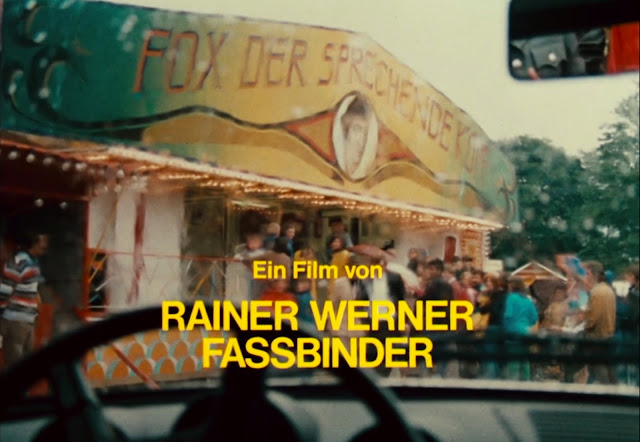
I've written a lot about Rainer Werner Fassbinder here at The Mumpsimus, and a few years ago created a video essay about his early films when Criterion released five of them as part of their (apparently discontinued) Eclipse series of bare-bones releases. I keep meaning to write more about RWF, to create new video essays (on Fassbinder and the recently deceased cinematographer Michael Ballhaus ; on queer Fassbinder), and I will eventually, but for now I simply want to point out that U.S. viewers, at least, now have access to a big selection of Fassbinder films via TCM's new streaming site, Filmstruck , which replaced Hulu as the home to Criterion's streaming service. I'm giving Filmstruck a test ride, and so of course have delved into the Fassbinder titles. (And I'm not alone in that: here's a good new piece from Brandon Soderbergh on them .) There's quite a lot that hasn't been available in the U.S. for a while, most notably Querelle , which is...

Notes on Theory of the Novel by Guido Mazzoni

Image
I've spent the last couple of weeks reading — almost devouring — Guido Mazzoni's Theory of the Novel ,  recently translated by Zakiya Hanafi from the Italian (a very clear translation of a complex text; not reading Italian, I can't vouch for its accuracy, but it's one of the most readable works of academic theory I've ever encountered). I'm still working through where I agree and disagree with Mazzoni, but however my thinking evolves regarding his ideas, the book is unquestionably impressive and thought-provoking, and particularly valuable in how it develops and clarifies some of the classic concepts in the field from Bakhtin, LukĂ¡cs, Erich Auerbach, and Ian Watt (among others). The only other recent book I've read that seems almost as clear and logical on similar topics is The Rhetoric of Fictionality  by Richard Walsh, a less ambitious, less fulfilling, and less elegant book than Mazzoni's, but useful in filling in around some of Mazzoni's edges...

A Quiet Passion

Image
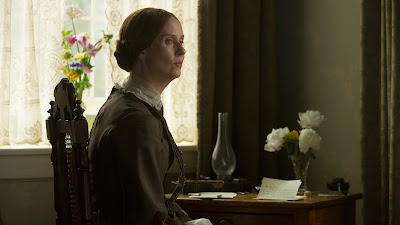
Few cinematic genres are as consistently awful as the biopic. Many of the greatest filmmakers have avoided any temptation to enter that genre, and the ones that, for reasons of finances or temporary insanity, did give it a shot usually ended up creating some of their worst films. (Mike Leigh is one of the few great filmmakers to have also created great biopics with Topsy-Turvy  and Mr. Turner .) Biopics of writers are especially hazardous. Most writers, after all, aren't as cinematic in their lives as Hunter S. Thompson or William S. Burroughs . Making the highly interior work of writing into something cinematically interesting is a nearly insuperable challenge, a challenge that usually results in Romantic clichĂ© and general absurdity. Which brings me to Terence Davies' latest film, A Quiet Passion , a biopic of Emily Dickinson , a writer with perhaps the least cinematic life of them all. I am fascinated by Dickinson's poetry, but I'm not a Davies acolyte...

Counternarratives by John Keene

Image
John Keene's Counternarratives  is one of the most impressive short story collections I've ever read from a living writer, and I was pleased to have the chance to write about it for my old blogosphere friend Dan Wickett, who does wonders celebrating short fiction via his Emerging Writers Network. Here's a taste: The stories of John Keene provide an aesthetic to push against the power of the cultural forces that venerate quick, easy thinking; forces that reduce knowledge to soundbites and hottakes and quick! mustread! breaking! stories, enforcing a compulsory presentism that is little more than mass amnesia — and self-aggrandizing mass amnesia at that. It’s a prose aesthetic to fight against any impulse insisting life here and life now is the most, the best, the worst, the only. His 2015 collection Counternarratives — easily one of the most invigorating English-language story collections of the last 25 years — offers us a powerful contemporary toolbox of approaches...

Experiments with Feedback and Grading in a First-Year Writing Course

Image
It's been a while since I last wrote here about teaching, for a simple reason: I've been teaching the same course, First-Year Writing, for a couple of years now, and haven't really had much to say about it. (Literature grad students at UNH used to be able to get some lit courses to teach after a required year of teaching what we colloquially call 401, but various forces related to lower enrollments made my cohort the last to get any lit courses [when I taught Literary Analysis and then an American lit survey], and so for the past two years I've taught nothing but 401). For the upcoming year, the university awarded me a Dissertation Year Fellowship, so I will not be teaching. Before all memory of the past few years leaves my mind, here are some reflections... This academic year, bored to death with my own teaching, I decided to experiment with the course a bit, and those experiments worked out well generally, so perhaps they are worth sharing here. Most of my ex...

wood s lot

Image
I am just coming to the news that Mark Woods, who ran the wood s lot site, died in February . I'd not been reading wood s lot regularly for a while — life got complex, internet reading more fragmented, and wood s lot  was just too rich, too full, too much: I hated skimming it, because it was material that needed to be absorbed more fully, more thoughtfully. I regret that, and am glad that the archives survive. I can't overstate the effect of wood s lot  on me in the early days of blogging here. (The consistent quality of the site is awe-inspiring. I look back through my own archives here and mostly think I'm looking at the doodles of a child. Read through the archives of wood s lot  and from the beginning you'll perceive a sharp mind arranging the signs and sights of the universe.) In the scrappy days before social networks and corporate bloggers, Mark Woods' site and David Auerbach's Waggish  offered a literary seriousness that made online writing see...

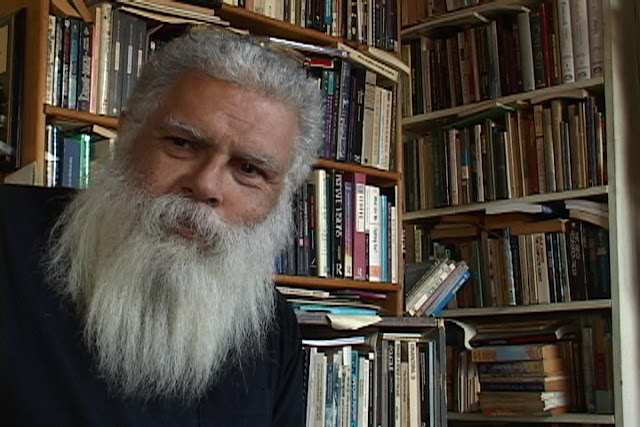
Delany at 75

Image
from The Polymath Samuel R. Delany just celebrated his 75th birthday, an auspicious occasion. I've been writing about Delany for over a decade now — I've written and published more about his work than about that of any other writer: introductions to new editions of The Jewel-Hinged Jaw , Starboard Wine , and The American Shore ; on his early pornographic novel Equinox ; on his recent novel Dark Reflections ; an interview in 2009 . I spent some time last summer researching in his archives at Boston University and expect to return this summer, as about a third of my doctoral dissertation (in progress...) is devoted to his work. I've given presentations about him at academic conferences, and all of my academic friends are probably quite tired of my invoking his name at every possible opportunity. The simple fact is that I think Delany is one of the most important American writers, one who ought to be spoken of alongside any great American writer (however defined or ...