Posts

Beating the Bounds by Liz Ahl

Image
Let me begin with disclaimer: This is not a review of Liz Ahl's first book-length collection of poems, Beating the Bounds . Liz is a longtime friend who sometimes writes about the place where I live and people I know, so anything I say about this book's qualities ought to be suspect. Further, I'm not very good at writing about poetry. I read a lot of poetry — well, "a lot" in comparison to most Americans, certainly, and probably in comparison to most writers who are not themselves poets — but have no facility for writing about poetry with much more insight than, "I like this line," or "Doesn't that sound nice?" What this post is, then, is not a review but a notice, plus quotations and anecdotes. Notice: Liz Ahl has published her first book-length collection of poems, Beating the Bounds . No book better captures what it looks like, smells like, sounds like, feels like to live in rural central New Hampshire than this book. That may s...


The Shape of Water

Image
Guillermo del Toro's The Shape of Water  was the opening film of the mini-festival Telluride at Dartmouth , and so I got to see it a few months before it will be released generally. I love del Toro's work — even when it falls flat for me ( Crimson Peak ), it's nonetheless clearly the work of someone with his own vision and style. And when I am on the same wavelength as the film ( The Devil's Backbone , Pan's Labyrinth , Pacific Rim ), the experience is overwhelmingly beautiful and moving. Indeed, that for me is the hallmark of del Toro at his best: real, unbridled emotion coupled with a visual imagination that is lushly inventive, and a sense for color the equal of any other director today. Del Toro is also a master melodramatist, a common form not frequently mastered. In that sense, he's our Douglas Sirk , but without Sirk's irony. (Perhaps we could say that del Toro replaces Sirk's irony with fantasy: melding a classical sense of melodrama with ...

A Convex Mirror: Twin Peaks

Image
That is the tune but there are no words.  The words are only speculation  (From the Latin speculum , mirror):  They seek and cannot find the meaning of the music.  We see only postures of the dream,  Riders of the motion that swings the face  Into view under evening skies, with no  False disarray as proof of authenticity.  But it is life englobed.  One would like to stick one's hand  Out of the globe, but its dimension,  What carries it, will not allow it. —John Ashbery 1. John Ashbery died on the day that Twin Peaks: The Returned  aired its final episode, a fact that will likely go unremarked in future Ashbery biographies and tomes of Twin Peaks  exegesis, but I can't help coming back to it, not only because Ashbery and David Lynch are two of the most prominent surrealists in American culture (though of course no one term can sum up either, and I use it here as much as a gesture or a plac...

My Heart Hemmed In by Marie NDiaye

Image
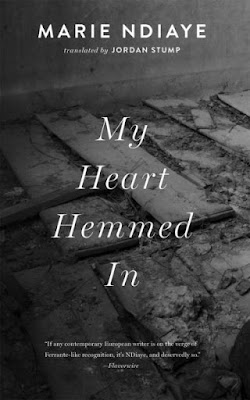
Marie NDiaye's 2007 novel Mon coeur Ă  l'Ă©troit  has now been translated by Jordan Stamp and published by Two Lines Press as My Heart Hemmed In . It is a strange, unsettling book, a tale told by a woman named Nadia whose husband receives a ghastly wound that he refuses to have treated, a woman who is being suddenly shunned not only by everyone she knows but apparently by everyone in the city of Bordeaux except for a famous writer she's never heard of, who appoints himself her husband's caretaker. She has an ex-husband who lives in destitution in their own apartment. She is estranged from her son, who once had a male lover (now a police inspector) whom Nadia might have been more in love with than her own child, and who then married a woman and had a daughter, Souhar, whose name Nadia detests. The novel's first paragraph is in many ways its guiding idea: Now and then, at first, I think I catch people scowling in my direction. They can't really mean me, can t...

What Is To Be Done About The Social Novel?

Image
Chernyshevsky in prison, painting by Gorovych (1953) The new issue of Harper's includes a review-essay by Jonathan Dee that asks a question summed up by the writer of the headline as "Does the social novel have a future?" Ultimately, though, the essay is not so much concerned with that question as with questions of imagination and representation. Dee reviews (or at least mentions) four recent books (three novels, one nonfiction account) which got him thinking about questions of what tends to be called "cultural appropriation" and the limits of fictionality. He admits he was skeptical of the idea of "cultural appropriation" until he read Go, Went, Gone by Jenny Erpenbeck and found himself thinking it's a good novel that also makes choices that he, when reading, grew uncomfortable with. I haven't read the books Dee writes about, but I expect I would generally agree with his assessment of them, and his description of Erpenbeck's bo...

"Grade Inflation" as a Path to Ungrading

Image
Cat Sidh, Flickr At Jacobin , Ed Burmila writes about grade inflation as a symptom of the neoliberalization of education , pointing out that there is no group within contemporary higher ed for whom there is much benefit to a lowering of grades, and, indeed, there are many groups for whom a lowering of grades is at best inconvenient and at worst utterly undesireable. This seems to me an accurate assessment, but it misses any sense of opportunity. Burmila laments the loss of meaning in grades and seems to yearn for a time when teachers were tough and gentlemen preferred Cs. There is an assumption within what he writes that grades and grade-point averages can be useful and meaningful. I don't entirely deny that grades can mean something. But  what  they mean is obscured by the simplification of a grade: one instructor's C is another's B is another's D. Grades provide an alibi for us, they let us pretend we're seeing an assessment when what we're seeing is ...

Shetland: Attending to the Consequences of Violence

Image
From now on, whenever someone argues that their story or tv episode or movie or whatever absolutely couldn't possibly work without a graphic rape scene, I will think of  episode 5 of the third series of the BBC show Shetland . The episode includes the kidnapping and rape of a regular series character. But we don't even see the kidnapping, only the moments leading up to it and then other characters' growing concern over the disappearance. She reappears, walking barefoot to a Glasgow police station, and at first there is relief: She's safe and she doesn't seem harmed. And then she tells the series' main character, DI Perez, that evidence will need to be collected. The rest of the episode and much of the final episode pay careful attention to her and her colleagues' work to come to grips with the event. The drama plays out through dialogue and restrained, thoughtful acting. I tend to watch murder shows with dinner. I'm quite used to munching away amid...