Posts

To the Lowest Hell with America: On James Purdy

Image
  In the 1960s, James Purdy’s writing was celebrated by such writers as Gore Vidal, Dorothy Parker, Tennessee Williams, and Paul Bowles. His first novel, Malcolm , was adapted as a Broadway play by Edward Albee. In 1964, Susan Sontag said that “anything Purdy writes is a literary event of importance”. On the cover of Tony Tanner’s 1971 study of contemporary writers, City of Words: American Fiction 1950-1970, Purdy’s name is prominently written alongside Joseph Heller, Saul Bellow, and Philip Roth; Tanner argues that Purdy’s 1965 novel Cabot Wright Begins is “one of the most important novels since the war.” Through the rest of the 20th century, Purdy published a new book every year or two, but those books garnered fewer and fewer reviews, sold fewer and fewer copies, and by the end of the 1980s much of his work was out of print and his new writings were published by small presses. Even as queer writers—especially white gay male writers like Purdy—were finding success with mainstr...

Time for Anxiety: "Pillar of Salt" by Shirley Jackson

Image
  Choosing a favorite Shirley Jackson story is nearly impossible. "The Lottery" is of course the famous one — easily among the most famous short stories in the English language — and because it is so ubiquitous, we (that is: I) can sometimes forget that it's also basically perfect. It is hard, though, to claim such an inescapable story as a favorite; to favor something, it mustn't feel as if it is always there.  For a long time, I've said "One Ordinary Day, with Peanuts" is my favorite, and it is certainly up there, a story of wonderful surprise and weird malice. So, too, "The Summer People" and "The Intoxicated" and plenty of others. But if we're talking about the story that I have read the most times, the story that I have returned to again and again to study how Jackson achieved what she did, then my favorite is clear: "Pillar of Salt". I first read it in the later 1980s when I was in middle school and got The Magic o...

10 Films After 10 Years

Image
The once-in-a-decade Sight and Sound poll of critics and filmmakers to determine the "greatest films of all time" is on the horizon — the 2012 one was published in the September issue of Sight and Sound , and people I know who have been invited to contribute their lists have done so in recent days. Since I am somewhat obsessed with the Sight and Sound poll, particularly how it has changed through the decades (the first poll occurred in 1952 ), I was surprised to find that I did not note here at The Mumpsimus the 2012 poll when it was released. I prepared for it by pointing to some lists I liked and making my own using Ignatiy Vishnavetsky's technique of making a big list of favorites and then randomly choosing 10. Looking at that post now, I see it also includes a link to what was Roger Ebert's final Sight & Sound list . 2012 does not feel like a long time ago to me. If you were to tell me that 2012 was three years ago, I would believe it. And yet, when I s...

Geoffrey H. Goodwin (1971-2022)

Image
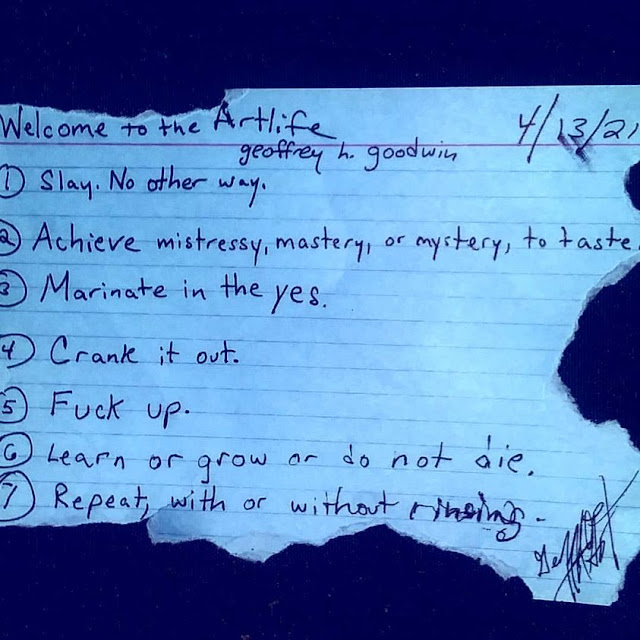
Banner image for Geoffrey Goodwin's Facebook page   Geoffrey H. Goodwin was a writer, a bookseller, a friend. He contributed here at The Mumpsimus in the early days, starting with a conversation about Hayao Miyazaki's film Howl's Moving Castle , which we saw together in Cambridge, Massachusetts when it was released in 2005. Geoffrey then contributed two interviews: one with Thomas Ligotti , another with Jedediah Berry . We had planned for Geoffrey to do more interviews and guest posts, but other commitments pulled him away. His final contribution here was to our Delany Roundtable in 2014. 2014 turned out to be a disaster year for Geoffrey. A car accident caused by a drunk driver brought significant physical and mental injury to him. His later years were extraordinarily difficult. His later years. Yes, Geoffrey is gone now, his death reported as cardiac failure , the failure of the literal heart of a person with, in the metaphorical sense, an extraordinary heart. It is ap...

A Conversation with Craig Laurance Gidney

Image
  Craig Laurance Gidney is a longtime friend of mine, a past contributor of book reviews here at The Mumpsimus, and a participant in our Delany roundtable in 2014 . I also had the pleasure to work as one of the editors for his story "Black Winged Roses" at The Revelator . It has been a joy to watch his career develop from his first short story collection, Sea, Swallow Me (Lethe Press, 2008) through to the success of his novel A Spectral Hue (Word Horde, 2019) and now his new story collection, The Nectar of Nightmares (Underland Press, 2022). About his work, Elizabeth Hand has said, "Sublime in the purest sense of the word, Craig Gidney's gorgeous stories evoke beauty, terror, and wonder, often — usually — on the same page. He uses words the way a master artist employs paint, creating lush, hallucinatory worlds as beautiful as they are treacherous." Craig's previous collections have all been nominated for the Lambda Literary Award, as was A Spectral Hue...

Some Queer Books

Image
The clickbait site Book Riot just released a list with the ridiculous title "The 100 Most Influential Queer Books of All Time" — as if such a thing could ever be determined. Influential how? For whom? Measured with what criteria?  The list itself is fine if you're looking for some new reading material, particularly from recent years (like many such lists, this one pays token attention to the past but is fundamentally interested in what's recent), but it's not much good for anything else — it does not include Gertrude Stein, Samuel Delany, Judith Butler, Edmund White, Dennis Cooper, Jean Genet, William S. Burroughs, Michel Foucault, or Kathy Acker, the exclusion of any one of whom renders the title meaningless. Such lists aim for a kind of objectivity that predestines them to be bland. What would be far more interesting would be lists from readers and writers of the books they themselves feel most affected by. Good lists pay no homage to the false gods of objectiv...