Posts

Blogging the Caine Prize: An Introduction

Image
Aaron Bady has come up with a great idea : since the Caine Prize for African Writing will be awarded in five weeks, and there are five short stories nominated, why not write about one story a week until the award? I'm going to throw myself into this, because I think the Caine Prize is important, and the exercise could be fun. I hope lots of other folks will join in. Here are the nominated stories, all available online as PDFs: NoViolet Bulawayo (Zimbabwe) ‘Hitting Budapest’ from ‘The Boston Review’ Vol 35, no. 6 - Nov/Dec 2010  [or direct link to the story at Boston Review ] Beatrice Lamwaka (Uganda) ‘Butterfly dreams’ from ‘Butterfly Dreams and Other New Short Stories from Uganda’ published by Critical, Cultural and Communications Press, Nottingham, 2010 Tim Keegan (South Africa) ‘What Molly Knew’ from ‘Bad Company’ published by Pan Macmillan SA, 2008 Lauri Kubuitsile (Botswana) ‘In the spirit of McPhineas Lata’ from ‘The Bed Book of Short Stories’ published by ...

Crabgrass and Manure

From the Letters of Note blog , a fascinating letter from Ken Kesey to the New York Times about the theatrical adaptation of his novel One Flew Over the Cuckoo's Nest (which starred Kirk Douglas): The answering of one's critics has always struck me as doing about as much good as fighting crabgrass with manure. Critics generally thrive on the knowledge that their barbs are being felt; best to keep silent and starve them of such attention, let them shrivel and dry, spines turned in. So I have tried to keep this silence during the attacks on the Wasserman play of my novel, One Flew Over The Cuckoo's Nest ...figuring that the people who saw the play as being about a mental hospital, because it is set in a mental ward, are the sort that would fault Moby Dick for being an "exaggerated" story about a boat, also figuring that such simplemindedness is relatively harmless. And even keeping silent when the play was condemned because the subject of mental health as a wh...

Review of Evaporating Genres

Strange Horizons yesterday posted my review of Gary K. Wolfe's Evaporating Genres: Essays on Fantastic Literature . That review begins by making a specific distinction between book reviews and a certain type of literary criticism, a distinction that Abigail Nussbaum considers in a blog post about the sorts of things she's looking for as Strange Horizons's reviews editor. I don't particularly disagree with the qualifications and complexities Abigail adds to what I wrote; the distinction I settled on was useful for that review, and seemed worth mentioning because it was absent from Wolfe's own taxonomy of reviews vs. criticism. As with so many things, in reality the distinctions are not hard and fast.

The Grim Miéville

Image
From an interview with China Miéville in The Socialist Worker : To this day, I often hear people on the left talk about "utopian, hopeful, progressive science fiction"--as if these are the same terms. Sometimes, "hopeful" fiction can be among the most reactionary. Sometimes, the "grimmest" and most depressive fiction might be really, really radical--or it might not, but it might be fantastic fiction. Obviously, there's a question of taste. If you don't like "grim books," you probably won't like some of my books. That's fine--that's taste. And you might well construct a political critique where you say, "The bleakness of these books is reactionary for the following reasons." That's fine. That's an analysis, and I might argue back. But to simply put out there that the books are in some way either lacking and/or politically reprehensible because they're downbeat is crazy. My favorite example about th...

Use and Abuse

Rohan Maltzen writes a memo to Marjorie Gerber about Gerber's new book The Use and Abuse of Literature : You are caught, I think, in the tension many of us feel between our theoretical commitment to an inclusive approach to literature (some aspects of which you discuss in your chapter on the literary "canon") and our deep appreciation for the aesthetic and intellectual richness of certain texts. As professionals, we have learned that this appreciation is itself conditioned by ideas about what "literature" is and how to measure its greatness. You celebrate close reading and lament a tendency (of which you give no specific examples, which is a problem) for "the historical fact [to take] precedence over the literary work." However, close reading works best—as you glancingly acknowledge when you tie it to Archibald MacLeish's lines "A poem should not mean / But be"—on texts that are verbally complex, ambiguous, and densely metaphorical, rath...

Readercon is Just Around the Corner, And...

Image
I was honored to be asked to join the programming committee for Readercon this year. Over the past 6 months or so, the committee, led brilliantly by Rose Fox , has come up with what will be, I think, a really interesting and diverse set of panels, discussions, talks, and readings. I just took a look at the items that will be heading out soon to participants for sign-up, and it's really satisfying to see where all of our discussions, brainstorming, and crazy ideas have led. Since Readercon is the only convention I attend regularly, it's fun to have the opportunity to help shape it a little bit. I just threw some ideas out there and wrote some descriptions of panels; the real work is being done by others , who are astoundingly dedicated and smart. I'm noting Readercon here first to remind you (yes, you !) that it would be nice to see you there (July 14-17, Burlington, Massachusetts), and also to note that Readercon now supports Con or Bust , a project of the Carl Brandon ...

The Unabomber's Books

Image
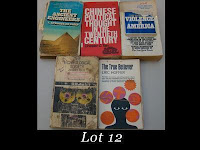
By court order, the U.S. government has to sell off Theodore " Unabomber " Kaczynski's stuff . Intrepid and well-funded buyers can bid on such things as the sunglasses and sweatshirt made famous in the forensic sketch , various tools and personal items, numerous manuscripts, and a few typewriters, including the one he used to write his manifesto. All good fun for the memento-seeker, and the proceeds go toward restitution to his victims' families. I was curious to see what books he had. Lot 12 consists of 5 paperbacks the FBI thought were particularly important: Chinese Political Thought in the Twentieth Century by Chester C. Tan, The Technological Society by Jacques Ellul, The True Believer by Eric Hoffer, Violence in America , and The Ancient Engineers by L. Sprague De Camp . Other lots include a well-worn Bible, a manual for wilderness survival, and various battered paperbacks mostly concerned with history and science, though there's also a collectio...