Posts

Negative Waves

Image
I haven't seen the movie Kelly's Heroes in ages, but what I most remember from it is something that became a running joke between my father and myself when I was a kid: Donald Sutherland's hippie-dippie character complaining about "negative waves". If something got too tense or critical, my father would deflect with a pretty good impression of Sutherland, saying something like, "Whoooooa, watch it with the negative waves, man!" Whenever I hear people complaining about reviewers (of books, movies, art, food, whatever) who are too negative, I can't help but hear Donald Sutherland's voice in my head. Negative waves, dude. Negative waves. When I first started writing reviews, the question of negativity was unavoidable. After all, right around the time I started reviewing, the world of litchat was obsessed with the question of "snark". The Believer was founded to combat those negative waves. Dale Peck's eviscerative style got every pu...

From AWP

Image
  I spent the last week in Seattle, Washington at the Association of Writers & Writing Programs Conference , a conference I have been going to off and on for more than fifteen years now. AWP has provided some great memories for me. I first attended when the conference was in Austin, Texas. I had been invited onto a panel with Jeff VanderMeer, Kelly Link, Laird Hunt, and Brian Evenson. (Wonder what became of any of them?) We also did a reading and had dinner with Michael Moorcock. Is it any wonder I remember virtually nothing else about that conference? Then there was the New York City conference where I worked in the Book Fair trying to sell or give away copies of Best American Fantasy and Weird Tales , which was a really exciting experience at the time because AWP was even more of a big-L Literature conference back then, and anything with "fantasy" in the title (never mind "Weird Tales"!) was quite a shock for some people. Then there was the Boston conference ...

Calm Weather and the Melancholy Tide

Image
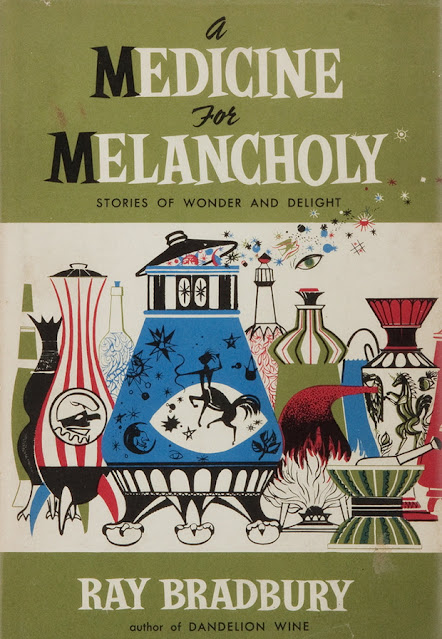
Recently, I got an inexpensive used copy of Twice Twenty-Two , a 1966 book made up of Ray Bradbury's story collections Golden Apples of the Sun (1953) and Medicine for Melancholy (1956) — the collections on either side of The October Country (1955). I've been revisiting Bradbury a bit over the last year or so. Though his stories were important to me when I was young, he's someone I hadn't read with any passion since childhood, thinking he was a writer whose childish spirit must not have much to say to me in adulthood. I was wrong. It may seem strange to say of someone who is so famous and beloved, but Bradbury is an easy writer to underestimate. We associate him with themes of childhood, with nostalgia, with sentimentality. And there is truth in those associations. But it was an essay by the wonderful horror writer Joel Lane (collected in This Spectacular Darkness ) that sent me back to Bradbury and convinced me that Bradbury's obsessive theme is less childhood t...

Boys for Pele

Image
It was a relatively warm January in New York City in 1996 when Tori Amos released her third solo album, Boys for Pele , which I bought on CD that week at Tower Records on Broadway. I don’t remember the day, but I do remember the big, lighted poster of the album’s cover displayed in the window of the store: Tori Amos with muddy legs, sitting in a rocking chair on what looks like a farmhouse porch, a hunting rifle in her hands, a dead rooster hanging to her side from the roof. I remember, too, the disorienting, invigorating shock of hearing “Blood Roses”, “Father Lucifer”, and “Professional Widow” for the first time. The music with which we feel our way through adolescence and early adulthood is often the music that ends up haunting the rest of our lives. My memory glues each of Tori Amos’s first three albums to specific, deeply meaningful moments of life and growth. The other albums for which I have such specific memories — memories of place and event, but even more so memories of sens...

Myths of Disenchantment

Image
  You know the story: once upon a time, the world was full of magic, then the Enlightenment and Darwin banished superstition, and though there was much scientific progress, the world no longer had a sense of wonder and mystery — the world had become modern and disenchanted. A moment’s reflection on history and culture will poke holes in this story, but it continues to hold power as a belief (particularly for people in North America and Europe) about who we are and how we got to here and now. Every idea of Modernity as a social and historical concept relies on the idea of the disenchanted modern against the enchanted primitive. (My own book on modernism explores the idea of crisis , and certainly enchantment/disenchantment fits into that topic.) Arguments about disenchantment tend to be about its extent and its positive and/or negative effects. The idea of disenchantment holds appeal because it fits so easily alongside other ideas that structure stories of where we are going and whe...

For Barry Lopez on His 78th Birthday

Image
  "Barry was not one to invest in answers. It was the questions that pulsed in his body and propelled him forward no matter where he traveled in the world." —Debra Gwartney, "Fire and Ice"   Barry Lopez died on December 25, 2020, shortly before January 6, 2021, which would have been his 76th birthday. Of course, that date two years now lives in infamy, a day of insurrection in the United States. Within the next few months, a little book I wrote in the wake of that day will be published: About That Life: Barry Lopez and the Art of Community . (It was originally scheduled to come out this past fall, but the publisher got a little backed up.) It will be published as an open-access book with a Creative Commons License by Punctum Books, so the PDF will be freely available and the paperback will be as affordable as possible. I will have more to say about the book when it is released. I want to note Lopez's birthday today, however. Of the people I have met in my life, ...

2022: Looking Backward

Image
  Another year gone. To this one, I am not quite so ready to say, “Good riddance!” as I was some other recent years, but I also have no great reason to want to hold on to 2022. I expect it is a year that will grow less and less defined in memory, its borders bleeding backwards and forwards, until it becomes the early 2020s and then sometime in the 2020s … When writing the recent Archive Dive post about past year-end summaries, I discovered I had not done one for 2021 … and I missed it. I regretted the handful of years I had not done any sort of summary, even just a basic list of favorite books. Not wanting to miss another year, I started taking notes for this one, and kept taking notes whenever anything occurred to me. So even though I'm sure there are plenty of items I've forgotten, it all get pretty long.  But the whole point of having a blog/newsletter/thing is to not be limited by the soundbite culture of social media, so I am going to glory in the opportunity to just go...